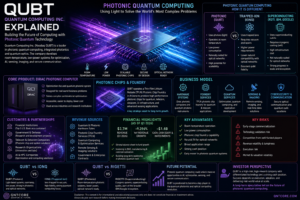
Quantum Computing Inc., traded on Nasdaq under the ticker QUBT, is one of the more unusual companies in the public quantum computing market.
Unlike IonQ, which focuses on trapped-ion quantum computing, or Rigetti, which focuses on superconducting quantum processors, Quantum Computing Inc. is centered on integrated photonics and quantum optics.
This makes QUBT a very different kind of quantum company.
The company is trying to build practical, room-temperature, low-power quantum and photonic systems that can be used for optimization, artificial intelligence, cybersecurity, remote sensing, imaging, and advanced computing applications.
For investors and technology followers, QUBT is important because it represents one of the most speculative but differentiated approaches in the quantum sector: photonic quantum computing.
What Does Quantum Computing Inc. Do?
Quantum Computing Inc. develops quantum photonic technologies and related systems designed to solve complex computational and sensing problems.
The company’s focus areas include:
- Photonic quantum computing
- Quantum optimization
- Reservoir computing
- Remote sensing
- Imaging
- Cybersecurity
- Thin-film lithium niobate photonic chips
- Quantum and photonic hardware systems
QUBT describes itself as a company building practical, scalable, room-temperature quantum photonics products that use the quantum nature of light to compute, capture data, and securely communicate across networks.
In simple terms, QUBT is not trying to build a traditional cryogenic quantum computer like IBM or Rigetti. It is trying to use light-based quantum systems to deliver useful computing and sensing solutions with lower power requirements and simpler operating conditions.
Core Technology: Photonic Quantum Computing
QUBT’s core technology is based on photonics.
Photonic quantum computing uses particles of light, called photons, to process quantum information. Instead of relying on superconducting circuits cooled close to absolute zero, or trapped ions controlled by lasers in vacuum systems, photonic systems use optical components and light-based signals.
This approach has several theoretical advantages.
Photons are naturally good for communication. They can travel through optical fibers and interact with existing telecom infrastructure. This makes photonics especially interesting for quantum networking, secure communication, and distributed computing.
Photonic systems may also operate at room temperature, which is a major difference from superconducting systems that require expensive cryogenic equipment.
According to the company’s SEC filings, Quantum Computing Inc. uses integrated photonics and nonlinear quantum optics to develop machines for quantum computing, reservoir computing, remote sensing, imaging, and cybersecurity. The company also says its products are designed to operate at room temperature and at very low power levels compared with superconducting, ion-trap, or annealing architectures.
This is the center of the QUBT investment story.
Why Room-Temperature Quantum Systems Matter
Most quantum computers require extremely controlled environments.
Superconducting quantum computers need dilution refrigerators that cool hardware close to absolute zero. Trapped-ion systems require vacuum chambers, lasers, and precise control systems.
These are powerful technologies, but they are expensive and complex.
QUBT’s photonic approach aims to reduce some of this complexity by developing quantum and photonic systems that can operate at room temperature and use lower power.
If successful, this could make deployment easier, cheaper, and more practical for certain enterprise, government, and research applications.
However, this is still a major technological challenge. Photonic quantum computing is promising, but it has not yet proven itself as the dominant commercial architecture.
Dirac Photonic Systems
One of QUBT’s most important product families is its Dirac system.
The Dirac systems are designed for optimization problems and quantum-inspired or quantum photonic computing tasks. These systems are part of QUBT’s effort to provide accessible quantum technology for real-world business and research problems.
Optimization is one of the most important early markets for quantum computing.
Examples include:
- Logistics routing
- Portfolio optimization
- Supply-chain planning
- Energy-grid balancing
- AI model optimization
- Manufacturing scheduling
- Defense planning
QUBT has positioned its photonic systems as practical tools for solving complex optimization and computing problems without requiring users to operate extremely complex cryogenic quantum hardware.
Thin-Film Lithium Niobate Photonic Chips
One of QUBT’s most important strategic assets is its work in thin-film lithium niobate, often abbreviated as TFLN.
TFLN is a photonic material platform used to build high-performance optical chips. It is important for applications such as:
- Optical communication
- Quantum photonics
- Datacom
- Telecom
- AI infrastructure
- Sensing
- Secure communication
QUBT completed construction of a Quantum Photonic Chip Foundry in Tempe, Arizona, which the company has described as a key milestone for meeting demand for TFLN photonic chips.
This matters because QUBT is not only trying to sell quantum machines. It is also trying to become a vertically integrated photonics company with its own chip foundry capability.
That could become strategically important if demand for photonic chips grows across AI, telecom, datacom, quantum networking, and sensing markets.
Business Model
QUBT’s business model is broader than a simple quantum cloud subscription model.
It includes several possible revenue streams.
1. Quantum and Photonic Hardware
QUBT develops physical quantum and photonic systems, including Dirac photonic computing machines and related hardware.
Hardware sales can generate larger contract values, but they may also be irregular from quarter to quarter.
2. Photonic Chip Foundry Services
The company provides foundry services for thin-film lithium niobate photonic chips. This could become an important business if demand for advanced photonics grows in telecom, AI infrastructure, and quantum applications.
3. Quantum Computing Services
QUBT can provide access to its systems and technology for enterprise, research, and government customers.
This may include optimization services, quantum photonic computing, and application development.
4. Remote Sensing and Imaging
The company’s technology also targets remote sensing and imaging markets. These areas may be relevant for defense, aerospace, environmental monitoring, industrial inspection, and scientific research.
5. Cybersecurity and Quantum Communication
Because photonics is naturally connected to secure communication and optical networks, QUBT also has potential exposure to cybersecurity and quantum-safe communication markets.
Customers and Commercial Traction
QUBT is still an early-stage commercial company, but it has begun reporting increasing revenue and customer activity.
In Q1 2026, Quantum Computing Inc. reported revenue of $3.7 million, compared with $39,000 in Q1 2025. The company also reported ending the quarter with approximately $1.4 billion in cash, cash equivalents, and investments.
That cash position is important because quantum and photonics development requires heavy investment.
QUBT has also reported growing demand for its products, including a notable sale to a top-five U.S. bank mentioned in 2025 coverage of its financial results.
The company’s customer opportunities appear to include:
- Financial institutions
- Government agencies
- Research organizations
- Telecommunications customers
- Datacom infrastructure companies
- Defense and aerospace markets
- AI and high-performance computing customers
However, investors should remember that QUBT remains early-stage. Its commercial traction is still developing and must be watched carefully over future quarters.
Revenue Sources
QUBT’s potential revenue sources include:
- Photonic quantum hardware sales
- Foundry services for TFLN photonic chips
- Quantum optimization services
- Quantum and photonic system access
- Remote sensing and imaging products
- Cybersecurity and quantum communication tools
- Government and enterprise contracts
The key question is whether these revenue sources can scale into a sustainable commercial business.
The company has reported early revenue growth, but it still must prove that demand can become repeatable and large enough to support long-term growth.
Competitive Position
QUBT competes in a crowded quantum and photonics landscape.
Its competitors and comparable companies include:
- IonQ
- Rigetti
- D-Wave
- IBM Quantum
- Google Quantum AI
- PsiQuantum
- Xanadu
- ORCA Computing
- Quandela
- other photonic and quantum hardware companies
QUBT is different from IonQ and Rigetti because it does not primarily use trapped-ion or superconducting qubits.
It is closer in theme to photonic quantum companies such as PsiQuantum, Xanadu, ORCA, and Quandela, although each company has its own technical architecture and commercialization strategy.
Photonic quantum computing attracted significant private capital in recent years, and industry reports have described photonics as one of the most important quantum hardware investment categories.
That creates both opportunity and competition.
Competitive Advantages
1. Room-Temperature Operation
QUBT’s room-temperature approach could reduce system complexity compared with cryogenic quantum platforms.
If this advantage proves commercially meaningful, QUBT could offer systems that are easier to deploy and operate.
2. Low-Power Photonic Architecture
The company emphasizes low-power operation. This could become important as AI, data centers, and advanced computing systems face rising energy constraints.
3. Photonic Chip Foundry
The Tempe photonic chip foundry gives QUBT potential exposure to broader demand for TFLN photonic chips across quantum, telecom, datacom, and AI infrastructure markets.
4. Broad Application Range
QUBT is not limited to one narrow quantum computing use case. Its technology may apply to optimization, sensing, imaging, cybersecurity, and communication.
5. Strong Cash Position
The company’s reported $1.4 billion in cash, cash equivalents, and investments gives it financial flexibility to fund commercialization, acquisitions, product development, and manufacturing expansion.
Key Risks
1. Early-Stage Commercialization
QUBT is still proving its business model. Revenue has increased, but the company must show that growth is repeatable and sustainable.
2. Technology Validation Risk
Photonic quantum computing is promising, but the market has not yet determined which quantum architecture will dominate.
QUBT must prove that its systems can deliver meaningful advantages for real customers.
3. Competition From Larger Players
QUBT competes with companies that have deeper resources, including IBM, Google, and well-funded private photonic companies.
4. Valuation Risk
Quantum stocks can trade on future expectations rather than current fundamentals. If investor enthusiasm declines, QUBT could experience significant volatility.
5. Customer Concentration and Revenue Lumpiness
Early-stage hardware and deep-tech companies often depend on a limited number of contracts or customers. This can make quarterly revenue uneven.
6. Execution Risk
Building quantum systems, scaling a photonic chip foundry, acquiring customers, and delivering products all require strong execution.
A delay in any of these areas could affect investor confidence.
QUBT vs IonQ
IonQ uses trapped-ion quantum computing.
QUBT uses photonic quantum systems.
IonQ’s advantage is its strong recognition as a pure-play quantum company and its high-fidelity trapped-ion technology. QUBT’s advantage is its room-temperature photonic approach and potential foundry business.
IonQ may be seen as more established in quantum computing. QUBT may be seen as more speculative but differentiated.
QUBT vs Rigetti
Rigetti uses superconducting quantum processors that require cryogenic cooling.
QUBT uses photonic systems designed for room-temperature and low-power operation.
Rigetti is competing more directly with IBM and Google’s superconducting model. QUBT is competing in the photonic quantum and quantum optics space.
This makes QUBT a different type of quantum stock.
QUBT vs D-Wave
D-Wave is known for quantum annealing and optimization.
QUBT also targets optimization, but through a different technological path using photonic systems.
Both companies may target near-term business problems, but D-Wave’s identity is built around annealing, while QUBT’s identity is built around photonics, quantum optics, and integrated photonic chips.
Future Potential
QUBT’s future potential depends on several factors.
First, the company must prove that its photonic systems can solve commercially valuable problems.
Second, it must scale its TFLN photonic chip foundry and convert demand into revenue.
Third, it must show that its technology can compete against better-funded quantum and photonic companies.
If QUBT succeeds, it could become an important player in quantum photonics, optical computing, sensing, and secure communication.
If it fails, it may struggle to turn promising technology into a sustainable business.
This makes QUBT one of the higher-risk but more differentiated quantum computing companies in the public market.
Investor Perspective
QUBT should be viewed as a speculative quantum and photonics company.
The bull case is that photonic quantum computing and TFLN photonic chips become commercially important across quantum computing, AI infrastructure, telecom, sensing, and cybersecurity.
The bear case is that the company’s technology remains too early, revenue does not scale, or competitors dominate the photonic quantum market.
For investors, QUBT is not simply a bet on quantum computing. It is also a bet on photonics, optical computing, chip foundry services, and the future role of light-based systems in advanced technology infrastructure.
Conclusion
Quantum Computing Inc. is one of the most differentiated public companies in the quantum sector.
Its focus on integrated photonics, quantum optics, room-temperature systems, low-power operation, and TFLN photonic chips sets it apart from IonQ, Rigetti, D-Wave, IBM, and Google.
However, differentiation alone is not enough.
QUBT must prove that its technology can generate sustainable revenue, attract serious customers, and deliver meaningful value in real-world applications.
For QNTCORE readers, QUBT is an essential company to understand because it represents one of the most unique paths toward quantum commercialization: using light itself as the foundation for next-generation computing and sensing.
Disclaimer
This article is for informational and educational purposes only and should not be considered financial or investment advice. Investors should conduct their own research before making investment decisions.