D-Wave Quantum is one of the most distinctive companies in the quantum computing industry. While many quantum companies focus primarily on gate-based quantum computing, D-Wave is best known for pioneering quantum annealing, a specialized approach designed for optimization problems.
This makes D-Wave different from companies such as IonQ, Rigetti, IBM, and Google. Rather than competing only on universal quantum computing, D-Wave has focused on solving practical optimization problems for enterprises, governments, and research institutions.
For investors and technology followers, D-Wave represents a different kind of quantum computing company: one that has spent years trying to commercialize quantum systems for real-world use cases.
What Does D-Wave Do?
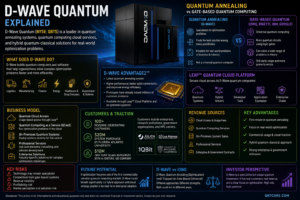
D-Wave develops quantum computing systems, software, cloud services, and professional services. Its main focus is helping customers apply quantum computing to complex optimization problems.
These problems can appear in industries such as:
- Logistics
- Manufacturing
- Financial services
- Materials science
- Drug discovery
- Energy systems
- Scheduling
- Supply chains
- Defense and government research
D-Wave offers access to its systems through its Leap quantum cloud platform and also supports enterprise-scale deployments.
D-Wave’s Core Technology: Quantum Annealing
D-Wave is best known for quantum annealing.
Quantum annealing is a type of quantum computing designed to find good solutions to optimization problems. In simple terms, optimization means finding the best possible outcome among many possible choices.
For example:
- What is the most efficient delivery route?
- How should a factory schedule production?
- How can a financial portfolio be optimized?
- How should energy resources be distributed?
- How can a complex material structure be modeled?
Quantum annealing is not the same as gate-based quantum computing. Gate-based systems are often described as more general-purpose and are pursued by companies such as IBM, Google, IonQ, and Rigetti.
D-Wave’s approach is more specialized, but specialization can be an advantage if the target problems are commercially valuable.
Quantum Annealing vs Gate-Based Quantum Computing
Understanding D-Wave requires understanding the difference between quantum annealing and gate-based quantum computing.
Gate-based quantum computers are designed to run quantum circuits using logic gates. This model is closer to the long-term vision of universal quantum computing.
Quantum annealers, by contrast, are designed to solve optimization problems by evolving a system toward a low-energy state that represents a good solution.
The key difference is this:
Gate-based quantum computing aims to become broadly programmable.
Quantum annealing focuses on specific optimization and sampling problems.
That means D-Wave may be more practical for some near-term business use cases, while gate-based quantum systems may have broader long-term potential if error correction and scaling improve.
Advantage2: D-Wave’s Advanced Quantum System
D-Wave’s Advantage2 system is one of the company’s most important technological milestones.
Advantage2 is designed to improve performance, connectivity, and energy efficiency compared with earlier systems. The system is available through D-Wave’s Leap cloud service and can also support on-premises deployment.
D-Wave has said that millions of customer problems have already been run through Advantage2 prototypes. This matters because it shows that D-Wave is not only building laboratory systems; customers are actively testing and using the platform.
Leap Quantum Cloud Service
D-Wave’s Leap platform gives customers cloud-based access to quantum computing resources.
This is important because most companies cannot buy and operate a quantum computer directly. Quantum systems require specialized infrastructure, cooling, control systems, and engineering expertise.
Through Leap, customers can access:
- Quantum annealing systems
- Hybrid quantum-classical solvers
- Developer tools
- Application examples
- Enterprise-grade quantum resources
This cloud-first model allows D-Wave to reach researchers, enterprises, and government customers without requiring every customer to install quantum hardware.
Hybrid Quantum-Classical Computing
D-Wave’s strategy is not purely quantum.
The company also emphasizes hybrid quantum-classical computing. In this model, classical computers and quantum systems work together.
This is important because many real-world problems are too large or complex to be handled by a quantum processor alone. Hybrid systems allow quantum resources to be used where they add value, while classical computing handles the surrounding workflow.
D-Wave’s hybrid solvers are designed to help customers explore optimization problems that may be difficult for classical systems to solve efficiently.
Business Model
D-Wave’s business model has several main components.
1. Quantum Cloud Access
Customers can access D-Wave’s quantum systems through the Leap cloud platform.
This creates a recurring or usage-based model where companies and researchers can experiment with quantum applications without buying hardware.
2. Quantum Computing as a Service
D-Wave offers quantum computing as a service for enterprise and institutional customers. This allows organizations to use quantum resources for optimization and research workloads.
3. On-Premises Quantum Systems
D-Wave also sells or deploys quantum systems for customers that want direct access to hardware.
This can generate larger contract values than basic cloud usage.
4. Professional Services
Many enterprises do not know how to translate business problems into quantum-ready applications.
D-Wave’s professional services help customers identify use cases, design workflows, and build quantum or hybrid applications.
5. Enterprise Solutions
D-Wave targets industries where optimization problems are commercially important. These include logistics, supply chains, finance, manufacturing, and energy.
Customers and Commercial Traction
D-Wave’s customer base includes commercial enterprises, research institutions, government organizations, and high-performance computing centers.
The company has reported revenue from more than 100 individual customers in recent quarterly results, with a significant portion coming from commercial enterprises.
D-Wave has also announced major customer activity, including a system purchase by Florida Atlantic University and a multi-year enterprise Quantum Computing as a Service agreement with a Fortune 100 company.
This is important because quantum computing companies are often criticized for being too experimental. D-Wave’s strategy is to show that quantum systems can already be used for practical optimization workloads.
Revenue Sources
D-Wave’s revenue can come from several sources:
- Cloud access
- Quantum computing services
- On-premises system sales
- Professional services
- Enterprise agreements
- Research and government contracts
However, investors should understand that quantum revenue can be uneven. A single system sale may significantly affect one quarter, while another quarter may appear weaker if fewer large transactions close.
This makes D-Wave’s financial results potentially “lumpy” compared with traditional software companies.
Competitive Advantages
1. First-Mover Advantage
D-Wave has been working on quantum annealing for many years and is one of the most established names in commercial quantum computing.
2. Specialized Optimization Focus
Many real-world business problems are optimization problems. D-Wave’s technology directly targets this category.
3. Commercial Usage
D-Wave has real customer activity and cloud usage, which gives it more commercial visibility than many early-stage quantum companies.
4. Hybrid Solver Strategy
By combining classical and quantum resources, D-Wave can offer more practical near-term solutions than relying only on pure quantum hardware.
5. Enterprise and Government Relevance
Optimization problems are important to logistics, defense, finance, manufacturing, and energy. These are large markets with serious operational challenges.
Key Risks
1. Quantum Annealing May Remain Specialized
D-Wave’s technology is powerful for certain optimization problems, but it may not have the same broad long-term potential as universal gate-based quantum computing.
2. Competition From Gate-Based Systems
If gate-based quantum computers become commercially useful faster than expected, D-Wave could face stronger competition from IBM, Google, IonQ, Rigetti, and others.
3. Revenue Volatility
Large system sales and enterprise contracts can create uneven quarterly revenue.
4. Profitability Risk
Like other quantum companies, D-Wave continues to invest heavily in research, development, sales, and commercialization.
5. Market Perception Risk
Some investors and researchers debate how quantum annealing compares with gate-based quantum computing. This can affect how the market values D-Wave relative to other quantum companies.
D-Wave vs IonQ
D-Wave and IonQ represent very different quantum strategies.
IonQ uses trapped-ion gate-based quantum computing. D-Wave focuses primarily on quantum annealing and optimization.
IonQ may be viewed as a broader long-term quantum computing platform. D-Wave may be viewed as more specialized and potentially more commercially practical for certain optimization problems today.
Neither model has fully won. The market may ultimately support multiple quantum architectures for different use cases.
D-Wave vs Rigetti
Rigetti focuses on superconducting gate-based quantum processors.
D-Wave’s core technology is quantum annealing, although the company has also expanded interest in gate-model systems through strategic moves.
Rigetti is more directly comparable to IBM and Google in architecture. D-Wave is more differentiated because it has historically focused on optimization through annealing.
Future Potential
D-Wave’s future depends on whether quantum annealing and hybrid quantum-classical computing can deliver real commercial value at scale.
The bull case is that optimization problems become one of the first commercially valuable quantum computing markets. If enterprises use D-Wave systems to reduce costs, improve logistics, optimize energy systems, or enhance industrial workflows, the company could build a strong position.
The bear case is that quantum annealing remains too narrow, customers delay adoption, or gate-based systems eventually dominate the most valuable quantum markets.
D-Wave’s long-term opportunity is tied to practical enterprise adoption rather than purely theoretical quantum breakthroughs.
Investor Perspective
D-Wave should be viewed as a speculative quantum computing company with a differentiated technology strategy.
It has real products, commercial customers, and a clear optimization-focused use case. However, it also faces intense competition, uncertain commercialization timelines, and the risk that quantum annealing remains a niche technology.
For investors, D-Wave is not simply “another quantum stock.” It is a distinct bet on whether optimization-focused quantum computing can become commercially valuable before universal fault-tolerant quantum computers arrive.
Conclusion
D-Wave Quantum is one of the most unique companies in the quantum computing sector.
Its focus on quantum annealing, hybrid solvers, cloud access, and enterprise optimization makes it different from IonQ, Rigetti, IBM, and Google.
While the company carries significant risks, it also offers exposure to one of the most practical near-term areas of quantum computing: optimization.
For QNTCORE readers, D-Wave is an essential company to understand because it represents a different path toward quantum commercialization.
Disclaimer
This article is for informational and educational purposes only and should not be considered financial or investment advice. Investors should conduct their own research before making investment decisions.