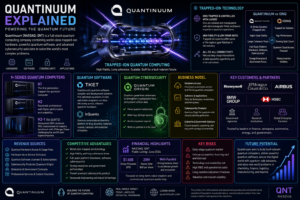
Quantinuum is one of the most important companies in the global quantum computing industry. Unlike many early-stage quantum startups that focus on only one part of the stack, Quantinuum is a full-stack quantum computing company with hardware, software, cybersecurity, chemistry applications, enterprise partnerships, and quantum cloud access.
The company was formed in 2021 through the combination of Honeywell Quantum Solutions and Cambridge Quantum. This merger created a rare quantum company with both advanced trapped-ion hardware and a mature quantum software platform.
In 2026, Quantinuum became a public company on Nasdaq under the ticker QNT after completing an upsized initial public offering. The company said it sold 28 million Class A shares at $60 per share, raising approximately $1.68 billion in gross proceeds before expenses.
For investors and technology followers, Quantinuum is one of the most serious companies to watch in the quantum computing race.
What Does Quantinuum Do?
Quantinuum develops quantum computers, quantum software, quantum cybersecurity products, and enterprise quantum applications.
Its business is built around several major areas:
- Trapped-ion quantum computers
- Quantum computing cloud access
- Quantum software tools
- Quantum chemistry applications
- Quantum cybersecurity
- Quantum random number generation
- Enterprise quantum solutions
- Research and government partnerships
This makes Quantinuum different from many pure hardware companies. It is not only trying to build better quantum machines; it is also trying to create products and software that customers can use before large-scale fault-tolerant quantum computers become mainstream.
Core Technology: Trapped-Ion Quantum Computing
Quantinuum’s core hardware technology is trapped-ion quantum computing.
In a trapped-ion system, charged atoms are isolated and controlled using electromagnetic fields and lasers. These ions act as qubits, the basic units of quantum information.
Trapped-ion systems are known for several strengths:
- High fidelity
- Long coherence times
- Strong qubit connectivity
- Precise quantum control
- Potential suitability for error correction
Quantinuum’s H-Series systems are among the best-known trapped-ion quantum computers in the industry.
This puts Quantinuum in the same broad technology category as IonQ, although the two companies have different architectures, products, business models, and commercialization strategies.
H-Series Quantum Computers
Quantinuum’s H-Series quantum computers are central to its hardware strategy.
The company’s System Model H1 was its first-generation trapped-ion quantum computer. Its System Model H2 introduced a racetrack-style architecture and became one of the most closely watched trapped-ion quantum systems in the world.
In 2024, Quantinuum announced a 56-qubit H2-1 trapped-ion quantum computer and said it had challenged the world’s best supercomputers on benchmark performance. Quantinuum also said it worked with JPMorgan Chase to achieve a 100x improvement over an existing industry benchmark using the H2-1 system.
This matters because quantum computing is not only about qubit count. The quality of qubits, connectivity, gate fidelity, error rates, and the ability to perform useful calculations all matter.
Quantinuum’s hardware story is built around performance, fidelity, and scalability rather than simply reporting the largest raw number of qubits.
Helios and the Hardware Roadmap
Quantinuum has also promoted Helios as part of its next-generation quantum hardware roadmap. The company describes Helios as a trapped-ion system with very high two-qubit gate fidelity and access through hardware-as-a-service models.
This is important because the company is trying to move beyond experimental systems and toward commercially useful quantum platforms.
Quantinuum’s roadmap focuses on:
- Better gate fidelity
- More qubits
- Lower error rates
- Stronger error correction
- Cloud and on-premises access
- Enterprise-grade quantum applications
The long-term goal is not simply to build larger quantum computers. The goal is to build machines that can solve commercially meaningful problems.
Quantum Error Correction
Quantum error correction is one of the most important challenges in the entire quantum computing industry.
Quantum systems are extremely sensitive to noise. Without error correction, calculations can fail before they become useful.
Quantinuum is widely viewed as one of the leading companies in quantum error correction research. Its trapped-ion systems have strong connectivity and fidelity characteristics that may be useful for error-corrected quantum computing.
This is one reason the company is taken seriously by researchers, governments, and large enterprise customers.
If Quantinuum can move from high-performance noisy intermediate-scale quantum systems toward fault-tolerant quantum computing, its long-term value proposition could become much stronger.
Quantum Software: TKET
Quantinuum is not only a hardware company.
Through Cambridge Quantum, Quantinuum inherited a strong software foundation. One of its most important software tools is TKET, a quantum software development and compiler platform.
TKET helps optimize quantum circuits and make quantum programs run more efficiently across different hardware platforms.
This is strategically important because quantum software can create value even before quantum hardware reaches full commercial maturity.
A strong software layer also helps Quantinuum serve customers across hardware ecosystems, not only on its own machines.
Quantum Chemistry and InQuanto
Another important Quantinuum product area is quantum chemistry.
InQuanto is Quantinuum’s computational chemistry platform designed to help researchers and enterprises explore quantum methods for chemistry, materials science, and molecular simulation.
This matters because chemistry and materials science are among the most promising long-term use cases for quantum computing.
Potential applications include:
- Drug discovery
- Battery materials
- Catalysts
- Fertilizers
- Hydrogen technology
- Advanced materials
- Chemical process optimization
Classical computers struggle to simulate many complex quantum systems efficiently. Because molecules and materials are quantum systems themselves, quantum computers may eventually become powerful tools for chemistry and materials discovery.
Quantum Cybersecurity: Quantum Origin
One of Quantinuum’s most commercially interesting products is Quantum Origin.
Quantum Origin is a quantum-generated randomness product designed to strengthen cryptographic keys. Quantinuum describes it as using proven quantum randomness to protect critical data, with deployment possible without extra hardware or a cloud connection.
This is important because cybersecurity may become one of the earliest commercial quantum markets.
The threat is simple: future quantum computers could break certain classical encryption systems. As a result, enterprises and governments are preparing for post-quantum cryptography and stronger key generation.
Quantum Origin gives Quantinuum a cybersecurity product that is not dependent on waiting for large-scale fault-tolerant quantum computers.
That makes Quantinuum different from companies that rely almost entirely on future quantum computing adoption.
Business Model
Quantinuum has a more diversified business model than many quantum companies.
1. Quantum Hardware Access
Customers can access Quantinuum’s H-Series quantum computers through cloud and enterprise access models.
This allows researchers, companies, and institutions to run quantum workloads without owning quantum hardware directly.
2. Hardware-as-a-Service
Quantinuum offers hardware access models that can include cloud-based, on-premises, or hybrid access.
This is important for governments and large enterprises that may want more control over sensitive workloads.
3. Quantum Software
Quantinuum generates potential value from software platforms such as TKET and InQuanto.
Software can support research, enterprise applications, chemistry workflows, and quantum algorithm development.
4. Cybersecurity Products
Quantum Origin gives the company exposure to cybersecurity and post-quantum cryptography markets.
This is one of Quantinuum’s most practical near-term commercial opportunities.
5. Enterprise and Government Projects
Quantinuum works with large enterprises, research institutions, and governments. These projects may include hardware access, software development, cybersecurity, chemistry applications, and custom quantum research.
Customers and Partners
Quantinuum has one of the strongest customer and partner profiles in the quantum industry.
Reported customers and partners have included:
- Honeywell
- JPMorgan Chase
- Airbus
- BMW Group
- HSBC
- Research institutions
- Government-linked organizations
- Enterprise technology partners
Reuters reported that Quantinuum’s technologies have been used by major global firms including Honeywell, Airbus, BMW Group, HSBC, and JPMorgan Chase.
JPMorgan Chase is especially important because the financial sector is one of the most promising early enterprise markets for quantum computing. Finance applications may include optimization, risk modeling, portfolio analysis, Monte Carlo simulation, and cybersecurity.
Airbus is also important because aerospace applications may include materials science, optimization, simulation, and advanced engineering.
Revenue Sources
Quantinuum’s potential revenue sources include:
- Quantum hardware access
- Hardware-as-a-service contracts
- Quantum software products
- Quantum chemistry software
- Quantum cybersecurity products
- Enterprise research contracts
- Government and institutional projects
- Professional services and application development
This creates a more diversified revenue base than companies that rely only on quantum cloud access or hardware sales.
However, Quantinuum remains an early-stage deep technology company. Revenue growth, margins, and profitability will depend on how quickly customers adopt quantum products and how successfully the company commercializes its full-stack platform.
Competitive Position
Quantinuum competes against some of the strongest companies in the quantum industry.
Major competitors include:
- IonQ
- IBM Quantum
- Google Quantum AI
- Microsoft Azure Quantum
- Rigetti Computing
- D-Wave Quantum
- PsiQuantum
- Xanadu
- Infleqtion
- Pasqal
Quantinuum’s strongest position is in trapped-ion quantum computing, enterprise quantum software, and quantum cybersecurity.
It is especially comparable to IonQ because both companies use trapped-ion architectures. However, Quantinuum may have a broader full-stack profile due to its combination of hardware, software, cybersecurity, and chemistry platforms.
Competitive Advantages
1. Full-Stack Quantum Platform
Quantinuum is not limited to one product. It has hardware, software, cybersecurity, and enterprise application layers.
This gives it multiple ways to create commercial value.
2. Strong Trapped-Ion Hardware
Quantinuum’s H-Series systems are widely recognized as high-performance trapped-ion quantum computers.
High fidelity and strong connectivity may be important advantages in the race toward fault-tolerant quantum computing.
3. Honeywell Engineering Heritage
Quantinuum benefits from Honeywell’s industrial engineering background and manufacturing expertise.
This may help as quantum hardware moves from laboratory systems toward commercial deployment.
4. Enterprise Customer Base
The company works with major global enterprises and financial institutions. This gives Quantinuum credibility with serious customers.
5. Cybersecurity Product Line
Quantum Origin gives the company a practical cybersecurity product that may generate value before fault-tolerant quantum computers are widely available.
6. Software Strength
TKET and InQuanto give Quantinuum a stronger software profile than many hardware-only quantum companies.
Key Risks
1. Early-Stage Market Risk
Quantum computing is still an emerging industry. Large-scale commercial adoption may take longer than investors expect.
2. Valuation Risk
After going public, Quantinuum’s valuation may reflect high expectations. If commercialization progresses slowly, the stock may be volatile.
3. Competition From Big Tech
IBM, Google, Microsoft, and Amazon have enormous financial and technical resources.
Quantinuum must keep advancing to maintain leadership.
4. Technology Risk
Trapped-ion quantum computing is promising, but the industry has not yet settled on one winning architecture.
Superconducting, photonic, neutral-atom, and annealing approaches may all win in different markets.
5. Profitability Risk
Quantum hardware, software, and cybersecurity development require major investment. Profitability may take time.
6. Execution Risk
Quantinuum must execute across multiple complex areas at once: hardware scaling, software commercialization, cybersecurity products, enterprise sales, manufacturing, and international expansion.
Quantinuum vs IonQ
Quantinuum and IonQ are two of the most important trapped-ion quantum computing companies.
IonQ is one of the most recognized pure-play quantum stocks and has built strong investor awareness around its trapped-ion roadmap.
Quantinuum, however, has a broader full-stack strategy. It combines trapped-ion hardware with TKET software, InQuanto chemistry tools, Quantum Origin cybersecurity, and enterprise partnerships.
In simple terms:
IonQ is more visible as a pure-play quantum computing investment.
Quantinuum may be broader as a full-stack enterprise quantum platform.
Both companies are important, and both could play major roles in the future quantum ecosystem.
Quantinuum vs IBM
IBM has one of the largest and most mature quantum ecosystems in the world. It has extensive cloud access, enterprise partnerships, software tools, and a major quantum roadmap.
Quantinuum is smaller than IBM but more focused. It does not have IBM’s broad technology business, but it has a strong trapped-ion architecture and a full-stack quantum platform.
IBM represents scale, ecosystem, and enterprise reach.
Quantinuum represents trapped-ion performance, software strength, and focused quantum commercialization.
Future Potential
Quantinuum’s future potential depends on several major questions.
First, can trapped-ion quantum computing scale toward fault-tolerant systems?
Second, can Quantinuum turn its software and cybersecurity tools into meaningful recurring revenue?
Third, can the company convert enterprise relationships into large commercial contracts?
Fourth, can it maintain leadership against IonQ, IBM, Google, and other quantum competitors?
If Quantinuum succeeds, it could become one of the most important quantum computing companies in the world.
If the industry develops more slowly than expected, or if another architecture becomes dominant, the company could face valuation pressure and commercialization challenges.
Investor Perspective
Quantinuum should be viewed as a high-quality but still speculative quantum computing company.
The bull case is that Quantinuum becomes one of the leading full-stack quantum platforms, combining hardware, software, cybersecurity, chemistry, and enterprise applications.
The bear case is that quantum computing commercialization takes longer than expected, revenue growth remains limited, and competition from large technology companies intensifies.
For investors, Quantinuum is not only a quantum hardware story. It is a broader bet on the future of quantum computing infrastructure, quantum software, quantum cybersecurity, and enterprise quantum adoption.
Conclusion
Quantinuum is one of the most important companies in the quantum computing industry.
Its trapped-ion hardware, H-Series systems, TKET software, InQuanto chemistry platform, Quantum Origin cybersecurity product, and enterprise customer base make it one of the most complete quantum companies in the market.
The company’s Nasdaq listing under QNT gives public market investors direct access to one of the strongest names in quantum technology.
However, risks remain significant. Quantum computing is still early, competition is intense, and commercialization timelines are uncertain.
For QNTCORE readers, Quantinuum is essential to understand because it may become one of the defining companies of the quantum era.
Disclaimer
This article is for informational and educational purposes only and should not be considered financial or investment advice. Investors should conduct their own research before making investment decisions.