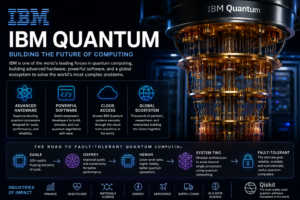
IBM is one of the most important companies in the global quantum computing industry.
Unlike many quantum startups that focus entirely on future commercialization, IBM has spent years building a complete quantum ecosystem that includes hardware, software, cloud infrastructure, research partnerships, enterprise customers, and developer tools.
Today, IBM operates one of the largest quantum computing networks in the world and has become a central player in the race toward fault-tolerant quantum computing.
For investors, researchers, and technology enthusiasts, IBM Quantum represents one of the most mature and comprehensive quantum computing platforms currently available.
What Is IBM Quantum?
IBM Quantum is the quantum computing division of IBM.
The company’s mission is to develop practical quantum computers capable of solving problems that are beyond the reach of classical computing systems.
IBM’s quantum strategy focuses on:
- Quantum hardware
- Quantum software
- Cloud access
- Enterprise adoption
- Research partnerships
- Quantum networking
- Quantum error correction
- Fault-tolerant quantum computing
Unlike many competitors, IBM is not simply building quantum processors.
IBM is building an entire quantum ecosystem.
Core Technology: Superconducting Quantum Computing
IBM uses superconducting qubits.
Superconducting quantum computers rely on electrical circuits cooled to temperatures near absolute zero.
At these temperatures, electrical resistance disappears and quantum behavior can be controlled with high precision.
IBM believes superconducting architectures provide a realistic path toward scaling quantum systems.
Advantages include:
- Fast gate operations
- Established semiconductor manufacturing techniques
- Large-scale integration potential
- Extensive research history
Challenges include:
- Cryogenic cooling requirements
- Noise reduction
- Error correction complexity
Despite these challenges, superconducting qubits remain one of the most advanced quantum computing approaches in the world.
IBM Quantum Processors
IBM has developed several generations of quantum processors.
Important systems include:
Eagle
IBM’s first processor to exceed 100 qubits.
Eagle demonstrated IBM’s ability to scale beyond previous hardware limitations.
Osprey
Built to further increase qubit count and hardware complexity.
Heron
One of IBM’s most important processors.
Heron focuses on:
- Improved fidelity
- Better performance
- Lower error rates
- Higher-quality quantum operations
Many experts consider Heron more important than raw qubit count because useful quantum computing depends heavily on quality rather than simply increasing the number of qubits.
IBM Quantum System Two
IBM Quantum System Two represents the company’s next-generation quantum computing platform.
Rather than focusing on a single processor, System Two is designed as a modular architecture capable of connecting multiple quantum processors together.
The goal is scalability.
IBM believes future quantum computers will require:
- Multiple quantum processors
- Quantum networking
- Advanced error correction
- Modular scaling
System Two is designed with that future in mind.
Quantum Error Correction
Error correction is one of the most important challenges in quantum computing.
Quantum systems are extremely sensitive to environmental noise.
Without error correction, calculations become unreliable.
IBM has invested heavily in:
- Error mitigation
- Error correction
- Logical qubits
- Fault-tolerant architectures
The company believes that fault-tolerant quantum computing is the key milestone that will unlock practical commercial applications.
Many analysts consider IBM one of the industry leaders in this area.
Quantum Software: Qiskit
One of IBM’s greatest strengths is its software ecosystem.
IBM developed Qiskit, one of the most widely used quantum programming frameworks in the world.
Qiskit allows developers to:
- Build quantum algorithms
- Simulate quantum circuits
- Access IBM quantum hardware
- Optimize quantum workloads
Thousands of researchers, students, and developers use Qiskit.
This creates a powerful ecosystem effect.
The more developers build with Qiskit, the stronger IBM’s position becomes.
IBM Quantum Network
IBM operates one of the world’s largest quantum computing networks.
The IBM Quantum Network includes:
- Fortune 500 companies
- Universities
- National laboratories
- Research institutions
- Government organizations
The network provides members with access to IBM quantum systems, software, research tools, and collaboration opportunities.
This ecosystem creates a significant competitive advantage because customers can begin experimenting with quantum technologies long before full-scale commercial deployment.
Customers and Partners
IBM Quantum works with organizations across many industries.
Examples include:
- JPMorgan Chase
- Boeing
- Airbus
- ExxonMobil
- Cleveland Clinic
- CERN
- Samsung
- Government research agencies
Potential use cases include:
Finance
- Portfolio optimization
- Risk analysis
- Fraud detection
Healthcare
- Drug discovery
- Molecular simulation
- Medical research
Aerospace
- Materials science
- Aircraft optimization
Energy
- Battery development
- Energy optimization
- Carbon capture research
Artificial Intelligence
- Hybrid AI systems
- Optimization workloads
IBM’s customer base is one of the strongest in the quantum industry.
Business Model
IBM Quantum generates value through multiple channels.
1. Quantum Cloud Access
Customers access IBM hardware through the cloud.
2. Enterprise Partnerships
Large organizations purchase access, support, and consulting services.
3. Quantum Software
Qiskit and related software tools support IBM’s ecosystem.
4. Research Collaborations
Government and institutional projects contribute to long-term growth.
5. Quantum Infrastructure
Future fault-tolerant systems could become a major commercial opportunity.
Competitive Advantages
1. Massive Resources
IBM has decades of research experience and substantial financial resources.
2. Enterprise Relationships
Few companies can match IBM’s global customer network.
3. Qiskit Ecosystem
Qiskit is one of the most adopted quantum software frameworks.
4. Quantum Network
IBM’s ecosystem creates significant barriers to entry.
5. Hardware Leadership
IBM remains one of the most advanced superconducting quantum computing companies.
6. Long-Term Commitment
IBM recently committed more than $10 billion toward quantum computing development over the coming years.
This demonstrates confidence in the technology’s future.
Key Risks
1. Technology Risk
Quantum computing remains a developing technology.
Commercial success is not guaranteed.
2. Competition
IBM faces competition from:
- Google Quantum AI
- Quantinuum
- IonQ
- Rigetti
- Microsoft
- Amazon
- PsiQuantum
3. Commercialization Timeline
Useful large-scale quantum applications may take longer than expected.
4. Cost
Quantum hardware development requires substantial investment.
IBM vs IonQ
IBM and IonQ pursue different approaches.
IBM:
- Superconducting qubits
- Massive enterprise ecosystem
- Strong software platform
- Broad research capabilities
IonQ:
- Trapped-ion technology
- High-fidelity operations
- Pure-play quantum focus
IBM may benefit from scale and enterprise reach.
IonQ may benefit from specialization and agility.
Both companies could succeed in different segments of the quantum market.
IBM vs Google
IBM and Google are widely viewed as two of the leading quantum hardware developers.
Google focuses heavily on breakthrough research.
IBM focuses on:
- Enterprise adoption
- Ecosystem development
- Commercial deployment
- Quantum infrastructure
These different strategies make direct comparisons difficult.
Future Potential
IBM believes quantum computing will eventually transform:
- Chemistry
- Materials science
- Logistics
- Artificial intelligence
- Cybersecurity
- Drug discovery
- Financial modeling
If fault-tolerant quantum computing becomes a reality, IBM is positioned to become one of the industry’s most influential players.
The company already has the ecosystem, customers, software, and infrastructure required for large-scale deployment.
Investor Perspective
For investors, IBM Quantum is different from most quantum companies.
Buying IBM is not a pure quantum investment.
IBM generates revenue from:
- Software
- Consulting
- Infrastructure
- Artificial intelligence
- Hybrid cloud
Quantum computing represents only one part of the broader business.
This reduces risk compared with many early-stage quantum companies.
However, it also means quantum breakthroughs may have less impact on IBM’s overall valuation than on smaller pure-play quantum companies.
Conclusion
IBM Quantum is one of the most advanced and influential organizations in the global quantum computing industry.
Its superconducting quantum processors, Qiskit software ecosystem, Quantum Network, System Two architecture, and commitment to fault-tolerant quantum computing make IBM a critical company to watch.
While risks remain, IBM’s combination of technology, customers, infrastructure, and long-term investment gives it one of the strongest positions in the quantum computing race.
For QNTCORE readers, IBM is essential because it represents one of the clearest examples of how quantum computing is moving from scientific research toward real-world commercial applications.
Disclaimer
This article is for informational and educational purposes only and should not be considered financial or investment advice. Investors should conduct their own research before making investment decisions.