Google Quantum AI is one of the most important quantum computing programs in the world.
Unlike pure-play quantum companies such as IonQ, Rigetti, D-Wave, QUBT, or Quantinuum, Google Quantum AI is part of one of the largest technology companies on the planet. This gives Google enormous advantages in research, engineering, artificial intelligence, cloud infrastructure, chip design, and long-term funding.
Google’s quantum strategy is not built around short-term revenue. It is focused on building a large-scale, error-corrected quantum computer capable of solving problems that classical computers cannot realistically solve.
For QNTCORE readers, Google Quantum AI is essential to understand because it represents one of the strongest “big tech” approaches to quantum computing.
What Is Google Quantum AI?
Google Quantum AI is Google’s quantum computing research and development division.
Its mission is to build useful quantum computers and develop the software, algorithms, and error-correction systems needed to make them practical.
Google Quantum AI focuses on:
- Superconducting quantum processors
- Quantum error correction
- Quantum algorithms
- Quantum software tools
- Quantum simulation
- AI-assisted quantum research
- Fault-tolerant quantum computing
- Scientific applications of quantum computers
Google is not simply trying to build a quantum chip. It is trying to build a complete quantum computing stack.
Core Technology: Superconducting Quantum Computing
Google uses superconducting qubits.
Superconducting quantum computers operate at extremely low temperatures, close to absolute zero. At these temperatures, specially designed electrical circuits can behave quantum mechanically and function as qubits.
This is the same broad architecture used by IBM and Rigetti.
Superconducting quantum systems are attractive because they can perform very fast quantum gate operations and may benefit from advanced chip fabrication techniques.
However, they also face major challenges:
- Cryogenic cooling requirements
- Noise sensitivity
- Error rates
- Scaling complexity
- Quantum error correction requirements
Google’s work is focused heavily on solving these challenges.
From Sycamore to Willow
Google became globally known in quantum computing after its Sycamore processor demonstrated a landmark quantum computing experiment in 2019.
That experiment showed that a quantum processor could perform a specific task much faster than a classical supercomputer.
However, Sycamore was not a practical commercial quantum computer. It was a scientific milestone.
Google’s more recent focus has shifted toward building systems that can correct errors and move closer to practical usefulness.
This is where Willow becomes important.
Willow: Google’s Breakthrough Quantum Chip
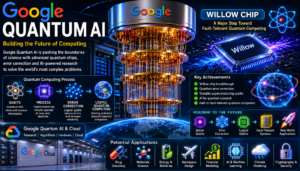
Willow is Google’s latest major quantum chip and one of the most important milestones in the company’s quantum roadmap.
Google introduced Willow as a step toward useful, large-scale quantum computing. The chip demonstrated progress in quantum error correction, one of the hardest problems in the industry.
The key achievement was that Willow showed error-corrected qubits could improve as the system became larger.
That matters because quantum systems normally become harder to control as more qubits are added. If adding more physical qubits can reduce logical errors, then the path toward scalable quantum computing becomes more realistic.
In simple terms:
Willow is important because it suggests that quantum computers can become more reliable as they scale.
That is one of the biggest requirements for fault-tolerant quantum computing.
Why Quantum Error Correction Matters
Quantum computers are fragile.
Qubits are easily affected by noise, heat, electromagnetic interference, and other environmental factors. These errors can destroy a quantum calculation.
Quantum error correction is the process of using many physical qubits to create more reliable logical qubits.
This is essential because useful quantum computers will need to run long and complex calculations.
Without error correction, quantum computers remain limited.
Google’s Willow milestone is important because it showed progress toward reducing errors using larger quantum codes.
For the quantum industry, this is a major signal that scalable quantum computing may be technically achievable.
Google’s Quantum Roadmap
Google Quantum AI is guided by a roadmap toward useful quantum computing.
The long-term goal is to build a fault-tolerant quantum computer capable of solving commercially and scientifically valuable problems.
Google’s roadmap includes:
- Building better physical qubits
- Demonstrating quantum error correction
- Scaling logical qubits
- Developing useful quantum algorithms
- Building fault-tolerant quantum systems
- Applying quantum computing to real-world scientific problems
This roadmap is not focused on near-term hype. It is focused on creating reliable quantum computers that can outperform classical systems on meaningful tasks.
Quantum Software and Cirq
Google also develops quantum software tools.
One of its most important tools is Cirq, an open-source Python framework for creating, editing, and running quantum circuits.
Cirq is designed for researchers and developers working with near-term quantum computers.
Software matters because quantum computing will not be useful with hardware alone. Developers need programming frameworks, simulators, optimization tools, compilers, and algorithm libraries.
Google’s software ecosystem helps researchers explore quantum algorithms and prepare for more advanced quantum hardware.
Business Model
Google Quantum AI does not operate like a normal standalone company.
Its business model is different from pure-play quantum companies.
1. Strategic Research and Development
Google invests in quantum computing as a long-term strategic technology.
The goal is to build capabilities that could eventually transform computing, artificial intelligence, materials science, and scientific discovery.
2. Cloud and Infrastructure Potential
If Google builds useful quantum computers, those systems could eventually be integrated into Google Cloud.
This could allow enterprise customers, researchers, and developers to access quantum computing through cloud services.
3. AI and Quantum Convergence
Google is one of the world leaders in artificial intelligence.
Quantum computing could eventually support AI-related optimization, simulation, and scientific discovery workloads.
This creates a long-term strategic connection between Google AI, DeepMind, and Google Quantum AI.
4. Scientific and Industrial Applications
Google is interested in applications such as:
- Materials science
- Chemistry
- Drug discovery
- Energy systems
- Optimization
- Machine learning
- Fundamental physics
These applications may eventually support commercial products, enterprise cloud services, or internal research advantages.
Customers and Ecosystem
Google Quantum AI is not primarily a customer-sales organization today.
It is a research-driven quantum program.
However, Google’s broader ecosystem gives it powerful future commercialization options.
Potential future users could include:
- Google Cloud customers
- Research institutions
- Pharmaceutical companies
- Materials science companies
- AI researchers
- Energy companies
- Government research agencies
- Scientific computing organizations
Unlike IonQ or D-Wave, Google does not need quantum computing to generate near-term revenue.
Google can fund quantum research for strategic advantage.
That is one of its biggest strengths.
Competitive Position
Google competes with some of the strongest quantum computing organizations in the world.
Major competitors include:
- IBM Quantum
- Microsoft Quantum
- Amazon Braket and AWS quantum efforts
- IonQ
- Quantinuum
- Rigetti
- D-Wave
- PsiQuantum
- Infleqtion
- academic and government quantum labs
Google’s strongest competition in superconducting quantum computing is IBM.
IBM has a stronger enterprise quantum ecosystem.
Google has one of the strongest research teams and a history of major scientific breakthroughs.
Google Quantum AI vs IBM Quantum
IBM and Google are often compared because both use superconducting qubits.
IBM focuses heavily on:
- Enterprise adoption
- Quantum cloud access
- Qiskit software
- Quantum Network partnerships
- Commercial ecosystem development
Google focuses heavily on:
- Scientific breakthroughs
- Quantum error correction
- Research leadership
- Long-term fault-tolerant computing
- AI and quantum integration
IBM may be stronger in enterprise commercialization.
Google may be stronger in fundamental research and AI-driven quantum development.
Both companies are important, and both could lead in different parts of the market.
Google Quantum AI vs IonQ
Google and IonQ use different quantum architectures.
Google uses superconducting qubits.
IonQ uses trapped-ion qubits.
Google’s advantages include:
- Massive research resources
- AI expertise
- Deep technical infrastructure
- Long-term funding
- Strong scientific teams
IonQ’s advantages include:
- Pure-play quantum focus
- Trapped-ion fidelity
- Public market visibility
- Direct commercial quantum strategy
Google is a big-tech research giant.
IonQ is a focused quantum company.
Both are important, but they represent very different investment and technology stories.
Google Quantum AI vs Rigetti
Google and Rigetti both use superconducting quantum technology.
The difference is scale.
Google has far greater financial, engineering, and AI resources.
Rigetti is a smaller pure-play quantum company focused on superconducting quantum processors and on-premises systems.
Google may have more research power.
Rigetti may have more direct commercial focus in certain institutional markets.
Competitive Advantages
1. Massive Financial Resources
Google can fund quantum research for years without needing immediate revenue.
This gives it a major advantage over smaller quantum companies.
2. AI Leadership
Google’s strength in artificial intelligence may help accelerate quantum research, quantum control, optimization, and algorithm development.
3. Research Talent
Google Quantum AI has one of the strongest quantum research teams in the world.
4. Willow Error Correction Milestone
Willow demonstrated meaningful progress toward scalable error-corrected quantum computing.
5. Cloud Infrastructure
Google Cloud could eventually become a platform for enterprise quantum computing access.
6. Long-Term Strategic Patience
Google does not need quantum computing to become profitable immediately.
It can treat quantum as a long-term strategic technology.
Key Risks
1. Commercialization Timeline Risk
Useful quantum computing may still take many years.
Google may achieve scientific breakthroughs long before broad commercial adoption.
2. Competition From IBM and Others
IBM, Microsoft, Amazon, IonQ, Quantinuum, and other companies are all racing toward practical quantum computing.
3. Superconducting Architecture Risk
Superconducting quantum computing is promising, but it may not be the final winning architecture.
Trapped-ion, photonic, neutral-atom, and other approaches may succeed in different areas.
4. No Pure-Play Investment Exposure
For investors, Google Quantum AI is only a small part of Alphabet.
Even major quantum progress may not directly move Alphabet’s valuation in the same way it could affect a pure-play quantum stock.
5. Technical Scaling Risk
Quantum error correction is extremely difficult.
Moving from research milestones to large-scale fault-tolerant machines remains a major engineering challenge.
Future Potential
Google Quantum AI could become one of the most important technology programs in the world if fault-tolerant quantum computing becomes practical.
Potential long-term applications include:
- Drug discovery
- Battery development
- Fusion research
- Materials science
- Climate modeling
- AI optimization
- Financial modeling
- Chemistry simulation
- Cryptography research
- Scientific discovery
Google’s strongest opportunity may be the combination of AI and quantum computing.
Artificial intelligence can help optimize quantum systems.
Quantum computing may eventually help solve scientific and optimization problems that are difficult for classical AI and classical computing.
If this convergence becomes real, Google could be one of the best-positioned companies in the world.
Investor Perspective
Google Quantum AI is not a pure quantum investment.
Alphabet is a diversified technology company with revenue from:
- Search
- Advertising
- YouTube
- Google Cloud
- Android
- AI
- Enterprise software
- Consumer products
Quantum computing is a long-term strategic option inside a much larger business.
That makes Alphabet less speculative than pure-play quantum stocks.
However, it also means quantum success may have less direct impact on the stock than it would for smaller quantum companies.
For investors, Google Quantum AI should be viewed as a strategic long-term technology asset rather than a near-term revenue driver.
Conclusion
Google Quantum AI is one of the most advanced quantum computing programs in the world.
Its superconducting quantum processors, Willow chip, quantum error correction progress, Cirq software tools, AI expertise, and long-term roadmap make it a central player in the race toward useful quantum computing.
While commercialization remains uncertain, Google has the financial resources, research talent, and infrastructure to stay at the front of the quantum race for years.
For QNTCORE readers, Google Quantum AI is essential because it shows how one of the world’s largest technology companies is preparing for the next major computing revolution.
Disclaimer
This article is for informational and educational purposes only and should not be considered financial or investment advice. Investors should conduct their own research before making investment decisions.