Microsoft is one of the most important companies in the quantum computing race.
Unlike pure-play quantum companies such as IonQ, Rigetti, D-Wave, or QUBT, Microsoft is approaching quantum computing as part of a much larger technology ecosystem that includes cloud computing, artificial intelligence, enterprise software, cybersecurity, and high-performance computing.
Microsoft’s quantum strategy is built around two major pillars:
- Azure Quantum as a cloud-based quantum platform
- Topological quantum computing as a long-term hardware strategy
This makes Microsoft one of the most ambitious and unusual players in the quantum industry.
What Is Microsoft Quantum?
Microsoft Quantum is Microsoft’s quantum computing division.
The company is working on:
- Quantum hardware
- Topological qubits
- Azure Quantum
- Quantum software
- Quantum algorithms
- Quantum cloud access
- Quantum chemistry
- Enterprise quantum applications
- Quantum error correction
- Hybrid quantum-classical computing
Microsoft’s long-term goal is to build a scalable quantum supercomputer that can solve problems beyond the reach of classical computers.
Core Technology: Topological Quantum Computing
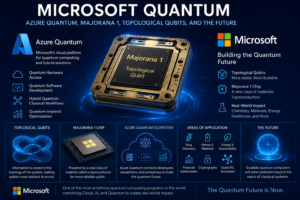
Microsoft’s most distinctive quantum strategy is its focus on topological qubits.
Most quantum companies use architectures such as:
- Superconducting qubits
- Trapped ions
- Photonics
- Neutral atoms
- Quantum annealing
Microsoft is taking a different path.
The company is trying to build quantum computers using topological qubits based on Majorana zero modes.
The idea is that topological qubits may be more stable than many other qubit types because quantum information is stored in the structure of the system rather than in fragile individual particles.
If successful, this could reduce error rates and make large-scale quantum computing easier to build.
Majorana 1 and Microsoft’s Quantum Breakthrough
Microsoft announced Majorana 1 as a quantum processor powered by topological qubits.
The company says this chip is built using a new class of material called a topoconductor.
Microsoft’s claim is important because practical quantum computing requires extremely low error rates. If topological qubits can deliver more stable quantum information, they may reduce the number of physical qubits needed for fault-tolerant systems.
This is why Majorana 1 is a central part of Microsoft’s quantum roadmap.
However, the technology remains controversial. Some researchers remain cautious because proving and scaling Majorana-based topological qubits is extremely difficult.
That makes Microsoft’s approach high-risk but potentially high-reward.
Azure Quantum
Azure Quantum is Microsoft’s cloud-based quantum computing platform.
It allows researchers, developers, enterprises, and institutions to explore quantum computing through Microsoft’s cloud ecosystem.
Azure Quantum provides access to:
- Quantum hardware partners
- Quantum-inspired optimization tools
- Quantum software development resources
- Hybrid quantum-classical workflows
- Scientific computing tools
This is strategically important because Microsoft does not need to wait for its own full-scale quantum computer before building a quantum ecosystem.
Through Azure Quantum, Microsoft can support customers today while continuing to develop its own hardware.
Azure Quantum Elements
Azure Quantum Elements is one of Microsoft’s most important commercial quantum-related platforms.
It combines:
- Artificial intelligence
- High-performance computing
- Quantum-inspired tools
- Scientific simulation
- Cloud infrastructure
This platform is designed for chemistry, materials science, and scientific discovery.
For example, companies may use Azure Quantum Elements to explore:
- Battery materials
- Catalysts
- Drug discovery
- Chemical reactions
- Advanced materials
- Energy storage
This is a key advantage for Microsoft.
Even before fault-tolerant quantum computers are widely available, Microsoft can sell quantum-adjacent tools through Azure.
Business Model
Microsoft’s quantum business model is broader than simply selling quantum computers.
1. Azure Cloud Revenue
Azure is already one of the largest cloud platforms in the world.
If quantum computing becomes commercially useful, Microsoft can integrate quantum services into Azure and offer them to enterprise customers.
2. Quantum Software and Tools
Microsoft can monetize quantum development tools, simulation software, and enterprise scientific computing platforms.
3. Enterprise Partnerships
Microsoft already has deep relationships with large corporations, governments, universities, and research institutions.
This gives it a powerful distribution channel for future quantum products.
4. AI and Quantum Integration
Microsoft is one of the biggest players in artificial intelligence.
Quantum computing may eventually support optimization, chemistry, materials science, and AI-related workloads.
This creates a long-term connection between Microsoft AI, Azure, and quantum computing.
5. Scientific Discovery Platforms
Azure Quantum Elements gives Microsoft a near-term commercial path in scientific computing, even before full-scale quantum computers are ready.
Customers and Ecosystem
Microsoft’s quantum ecosystem includes:
- Enterprises
- Universities
- Research institutions
- Cloud developers
- Government agencies
- Materials science companies
- Pharmaceutical researchers
- Chemistry and energy companies
Microsoft’s biggest advantage is not only hardware.
It is distribution.
If quantum computing becomes useful, Microsoft can deliver it through Azure to thousands of enterprise customers.
This is something most pure-play quantum companies cannot easily replicate.
Microsoft vs IBM Quantum
IBM and Microsoft are both major enterprise technology companies, but their quantum strategies are different.
IBM uses superconducting qubits and has built one of the largest quantum ecosystems through Qiskit and IBM Quantum Network.
Microsoft focuses on topological qubits, Azure Quantum, and scientific cloud platforms.
IBM appears more advanced in deployed quantum systems.
Microsoft may have a more differentiated long-term hardware strategy if topological qubits work.
In simple terms:
IBM is ahead in visible quantum ecosystem deployment.
Microsoft is making a bold bet on a potentially more scalable qubit architecture.
Microsoft vs Google Quantum AI
Google Quantum AI is focused heavily on superconducting qubits, quantum error correction, and scientific breakthroughs such as Willow.
Microsoft is focused on topological qubits and cloud-based quantum infrastructure through Azure.
Google’s strength is research leadership and AI.
Microsoft’s strength is enterprise cloud distribution and software integration.
Both companies are long-term quantum leaders, but their strategies are very different.
Microsoft vs IonQ
IonQ is a pure-play quantum company focused on trapped-ion technology.
Microsoft is a diversified technology giant focused on topological quantum computing and cloud infrastructure.
IonQ gives investors more direct quantum exposure.
Microsoft gives investors broader exposure to cloud, AI, enterprise software, and quantum as a long-term optionality.
IonQ is more specialized.
Microsoft is more diversified.
Competitive Advantages
1. Azure Cloud Platform
Azure gives Microsoft a massive advantage in distributing future quantum services.
2. Enterprise Relationships
Microsoft already works with many of the world’s largest companies and governments.
3. AI Integration
Microsoft’s AI ecosystem could eventually combine with quantum computing for scientific discovery, optimization, and simulation.
4. Topological Qubit Strategy
If topological qubits work at scale, Microsoft could gain a major technological advantage.
5. Long-Term Funding Capacity
Microsoft can invest in quantum research for years without needing immediate revenue from quantum products.
6. Scientific Computing Platform
Azure Quantum Elements gives Microsoft a near-term product connected to chemistry, materials science, and advanced research.
Key Risks
1. Topological Qubit Risk
Microsoft’s quantum hardware strategy is ambitious but technically difficult.
If topological qubits do not scale as expected, Microsoft may fall behind other architectures.
2. Competition
Microsoft competes with IBM, Google, Amazon, IonQ, Quantinuum, Rigetti, D-Wave, and other quantum companies.
3. Commercialization Timeline
Useful quantum computing may take longer than investors and enterprises expect.
4. Limited Pure-Play Exposure
Quantum computing is only one part of Microsoft’s massive business.
Even major quantum progress may not directly move Microsoft’s overall valuation in the same way it could affect a smaller pure-play quantum stock.
5. Scientific Skepticism
Because Majorana-based quantum computing is complex and controversial, Microsoft must continue proving its claims through technical progress and peer-reviewed validation.
Future Potential
Microsoft’s long-term quantum opportunity is extremely large.
If its topological qubit strategy succeeds, Microsoft could build a scalable quantum computing platform integrated directly into Azure.
Potential applications include:
- Drug discovery
- Battery research
- Materials science
- Energy systems
- Climate modeling
- Financial optimization
- Cryptography
- Artificial intelligence
- Advanced manufacturing
- Scientific simulation
The most powerful part of Microsoft’s strategy is the combination of:
- Azure
- AI
- Quantum
- Enterprise software
- Scientific computing
If these pieces come together, Microsoft could become one of the most important quantum infrastructure companies in the world.
Investor Perspective
Microsoft Quantum should not be viewed like a pure quantum stock.
Microsoft is a diversified technology giant with revenue from:
- Cloud computing
- Office software
- Windows
- Gaming
- Artificial intelligence
- Enterprise software
- Cybersecurity
Quantum computing is a long-term strategic asset inside a much larger business.
This reduces risk but also reduces direct quantum exposure.
For investors, Microsoft represents a lower-risk way to gain exposure to quantum computing compared with speculative pure-play quantum stocks.
However, the quantum upside may be less dramatic because Microsoft’s valuation is driven mostly by cloud, AI, software, and enterprise revenue.
Conclusion
Microsoft Quantum is one of the most ambitious quantum computing programs in the world.
Its strategy is built around Azure Quantum, topological qubits, Majorana-based hardware, scientific computing platforms, and long-term enterprise adoption.
The company’s approach is risky because topological quantum computing remains technically difficult. But if Microsoft succeeds, it could create one of the most scalable and commercially powerful quantum platforms in the industry.
For QNTCORE readers, Microsoft Quantum is essential to understand because it combines three of the most important technology themes of the next decade:
Cloud computing, artificial intelligence, and quantum computing.
Disclaimer
This article is for informational and educational purposes only and should not be considered financial or investment advice. Investors should conduct their own research before making investment decisions.