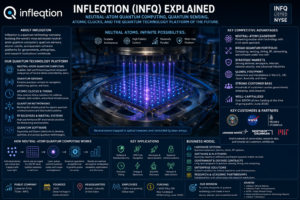
Infleqtion is one of the most important emerging companies in the quantum technology sector.
Unlike many quantum companies that focus only on quantum computing, Infleqtion has built a broader quantum technology platform that includes neutral-atom quantum computing, quantum sensing, atomic clocks, quantum networking, radio-frequency receivers, and quantum software.
This makes Infleqtion different from companies such as IonQ, Rigetti, D-Wave, QUBT, IBM Quantum, Google Quantum AI, and Microsoft Quantum.
Infleqtion is not only trying to build the future of quantum computers. It is also building quantum devices that may be useful earlier in defense, aerospace, positioning, navigation, timing, telecommunications, and sensing.
In 2026, Infleqtion became a public company trading under the ticker INFQ, making it one of the most important public quantum technology names to watch. The company described itself as the first neutral-atom quantum company to go public and said it had more than $550 million of new funding after the transaction. (Infleqtion)
What Does Infleqtion Do?
Infleqtion develops quantum technologies based largely on neutral atoms.
The company’s product areas include:
- Neutral-atom quantum computers
- Quantum sensors
- Atomic clocks
- Quantum software
- Quantum networking
- Radio-frequency receivers
- Inertial sensors
- Quantum security applications
Infleqtion says it engineers neutral-atom quantum computers, precision sensors, and software for governments, corporations, and research institutions worldwide. The company also highlights global installations in the United States, United Kingdom, Japan, and Australia, along with hundreds of quantum customers. (Infleqtion)
This broad approach is important because quantum computing may take years to fully commercialize, while quantum sensing and timing products may have earlier real-world demand.
Core Technology: Neutral-Atom Quantum Computing
Infleqtion’s core technology is neutral-atom quantum computing.
Neutral atoms are atoms with no net electric charge. In a quantum computer, these atoms can be cooled, trapped, and controlled using lasers.
In simple terms, neutral-atom quantum computing uses carefully controlled atoms as qubits.
This architecture has several potential advantages:
- Large numbers of atoms can be arranged in arrays
- Atoms are naturally identical
- Systems may scale to many qubits
- Laser control allows flexible manipulation
- Neutral atoms can support computing, sensing, and timing applications
Neutral-atom quantum computing is one of the major competing approaches in the industry, alongside trapped ions, superconducting qubits, photonics, and quantum annealing.
Infleqtion’s strategy is built around the idea that neutral atoms can become a scalable platform not only for quantum computing but also for multiple quantum technologies.
Why Neutral Atoms Matter
Quantum computing is not only a race for more qubits.
The real challenge is building systems that can scale, remain stable, reduce errors, and solve useful problems.
Neutral atoms are attractive because they may allow large arrays of qubits to be created and manipulated with optical systems.
This makes the architecture interesting for:
- Quantum simulation
- Optimization
- Fault-tolerant quantum computing
- Quantum networking
- Quantum sensing
- Precision measurement
Infleqtion has positioned itself as a full-stack neutral-atom quantum company, meaning it is not limited to only one application.
Infleqtion’s Product Platform
Infleqtion has a broader product portfolio than many quantum startups.
According to the company, its product portfolio spans quantum computers, quantum optical clocks, RF receivers, and inertial sensors, supported by its Superstaq quantum software platform. (Infleqtion)
This is important because Infleqtion is not only a future quantum computer story.
It is also a quantum hardware, sensing, timing, and software company.
Superstaq: Quantum Software Platform
Superstaq is Infleqtion’s quantum software platform.
Quantum software is important because hardware alone is not enough. Developers and enterprises need software tools that can optimize circuits, improve performance, and make quantum systems easier to use.
Superstaq is designed to improve quantum program execution by optimizing how quantum circuits are compiled and run.
This matters because early quantum systems are limited by noise, error rates, and hardware constraints. Better software can improve performance before hardware reaches full fault tolerance.
For Infleqtion, Superstaq helps connect its hardware strategy with developers, researchers, and enterprise users.
Oqtant: Quantum Matter Service
Oqtant is another important Infleqtion platform.
Infleqtion launched Oqtant as a quantum matter service designed to give users access to quantum matter through a cloud platform. The company described it as a way to accelerate new quantum discoveries, product development, and technology innovation. (Infleqtion)
This is a different concept from a standard quantum cloud computer.
Instead of only providing access to qubits for computation, Oqtant is designed around interacting with quantum matter for research and development.
Potential users include:
- Researchers
- Universities
- Materials scientists
- Quantum developers
- Advanced technology companies
Quantum Sensing
Quantum sensing is one of the most important parts of Infleqtion’s strategy.
Quantum sensors use quantum effects to measure physical quantities with extreme precision.
Potential applications include:
- Navigation without GPS
- Gravity sensing
- Defense and aerospace
- Underground mapping
- Climate and environmental monitoring
- Precision timing
- Battlefield awareness
- Infrastructure monitoring
This is one area where Infleqtion may have earlier commercial opportunities than companies focused only on quantum computing.
Quantum sensing could become important for national security, space systems, geophysics, and industrial applications.
Atomic Clocks and Precision Timing
Infleqtion also works on atomic clocks and precision timing systems.
Atomic clocks are extremely accurate timekeeping devices based on atomic transitions. They are essential for many modern technologies.
Potential applications include:
- GPS
- Telecommunications
- Data centers
- Defense systems
- Financial networks
- Secure communications
- Navigation
Infleqtion’s atomic clock technology is strategically important because accurate timing is a critical infrastructure need.
If GPS signals are jammed, spoofed, or unavailable, alternative timing and navigation systems become valuable.
This is why atomic clocks and quantum timing systems are highly relevant for defense and national security.
Quantum Networking
Quantum networking is another important long-term area.
Quantum networks may eventually connect quantum computers, sensors, and secure communication systems.
Infleqtion’s neutral-atom technology and quantum hardware platform may be relevant for future distributed quantum systems.
Potential quantum networking applications include:
- Secure communication
- Distributed quantum computing
- Quantum sensor networks
- Defense communications
- Scientific research networks
This is still an early market, but it may become strategically important as quantum systems mature.
Business Model
Infleqtion’s business model is broader than a simple quantum cloud subscription model.
1. Quantum Computing Systems
Infleqtion develops neutral-atom quantum computers and related hardware platforms.
This gives the company exposure to the long-term quantum computing market.
2. Quantum Sensors
Quantum sensing may provide earlier commercial demand in defense, aerospace, national security, and industrial markets.
3. Atomic Clocks and Timing Products
Precision timing products may serve telecommunications, data centers, defense systems, and navigation applications.
4. Software
Superstaq gives Infleqtion a software layer that can support customers using quantum systems.
5. Government and Research Contracts
Quantum technology is strategically important for governments. Infleqtion’s systems are reported to be used by organizations including the U.S. Department of Defense, NASA, and U.K. government-linked customers. (Daily Telegraph)
6. Enterprise and Industrial Applications
Over time, Infleqtion may serve industries such as energy, aerospace, telecommunications, finance, and advanced manufacturing.
Customers and Partners
Infleqtion serves governments, research institutions, corporations, and advanced technology customers.
Its customer base is important because quantum technologies are still early and often require sophisticated buyers.
Potential customer categories include:
- Defense agencies
- Space agencies
- National laboratories
- Universities
- Aerospace companies
- Telecommunications companies
- Data center operators
- Research institutions
- Advanced industrial customers
The company has emphasized that its systems are already in use across government and institutional environments. (Infleqtion)
Competitive Position
Infleqtion competes in several quantum markets at once.
Its competitors include:
- IonQ
- Quantinuum
- IBM Quantum
- Google Quantum AI
- Microsoft Quantum
- Rigetti
- D-Wave
- Pasqal
- QuEra
- Atom Computing
- QUBT
- PsiQuantum
The most direct comparison is with other neutral-atom quantum companies such as Pasqal, QuEra, and Atom Computing.
However, Infleqtion is broader because it combines computing, sensing, timing, networking, and software.
Infleqtion vs IonQ
IonQ uses trapped-ion quantum computing.
Infleqtion uses neutral atoms.
IonQ is one of the best-known pure-play quantum computing stocks and focuses heavily on quantum computing and networking.
Infleqtion is broader. It targets quantum computing but also quantum sensors, atomic clocks, RF receivers, and timing systems.
IonQ may be more recognized by public investors.
Infleqtion may be more diversified across multiple quantum technologies.
Infleqtion vs Rigetti
Rigetti uses superconducting qubits.
Infleqtion uses neutral atoms.
Rigetti is more directly focused on quantum processors and hybrid quantum-classical systems.
Infleqtion has broader exposure to defense, sensing, timing, and networking.
This makes Infleqtion less like a pure quantum computer company and more like a diversified quantum technology platform.
Infleqtion vs D-Wave
D-Wave is best known for quantum annealing and optimization.
Infleqtion is focused on neutral atoms, sensing, clocks, and full-stack quantum systems.
D-Wave may have stronger positioning in near-term optimization applications.
Infleqtion may have stronger exposure to defense, timing, sensing, and long-term neutral-atom quantum computing.
Infleqtion vs Microsoft Quantum
Microsoft is building a long-term quantum strategy around topological qubits, Azure Quantum, and cloud infrastructure.
Infleqtion is building neutral-atom quantum hardware and quantum devices.
Microsoft has massive financial and cloud distribution advantages.
Infleqtion has a more focused quantum hardware and sensing identity.
Microsoft is a big-tech quantum platform.
Infleqtion is a specialized quantum technology company.
Competitive Advantages
1. Neutral-Atom Architecture
Neutral atoms may offer a scalable path for quantum computing and quantum simulation.
2. Broad Quantum Product Portfolio
Infleqtion is not dependent only on future quantum computing adoption. It also has sensing, timing, RF, and software products.
3. Government and Defense Relevance
Quantum sensing, timing, and GPS-free navigation are highly relevant to defense and national security.
4. Full-Stack Approach
Infleqtion combines hardware, software, sensors, clocks, and networking.
5. Public Market Access
As a public company under INFQ, Infleqtion gives investors direct exposure to neutral-atom quantum technology.
6. Strategic Funding
Infleqtion said it was well-capitalized after going public with more than $550 million of new funding. (Infleqtion)
Key Risks
1. Early-Stage Commercialization
Quantum technology is still early. Infleqtion must prove that its products can scale commercially.
2. Technology Risk
Neutral-atom quantum computing is promising, but the industry has not yet determined which quantum architecture will dominate.
3. Execution Risk
Infleqtion must execute across several complex product categories at once: computing, sensing, clocks, RF systems, networking, and software.
4. Competition
Large companies and well-funded startups are competing aggressively in quantum computing and sensing.
5. Revenue Scaling Risk
Government and research contracts can be important but may not always scale like commercial software or cloud revenue.
6. Valuation Risk
Quantum stocks can be volatile because investors often price them based on future potential rather than current fundamentals.
Future Potential
Infleqtion’s future potential depends on whether neutral-atom quantum technologies can scale and whether quantum sensing products become commercially important.
The bull case is that Infleqtion becomes a major platform for:
- Neutral-atom quantum computing
- Quantum sensors
- Atomic clocks
- GPS-free navigation
- Quantum networking
- Defense quantum systems
- Scientific quantum tools
The bear case is that quantum computing commercialization takes longer than expected, sensing adoption remains limited, and larger competitors capture the market.
The most interesting part of Infleqtion’s story is that it does not need only one market to succeed.
It has exposure to several quantum technology markets at the same time.
Investor Perspective
Infleqtion should be viewed as a speculative but differentiated quantum technology company.
It is not just another quantum computing stock.
It is a neutral-atom quantum computing, quantum sensing, atomic clock, RF receiver, and quantum software company.
That gives Infleqtion a broader technology base than many pure-play competitors.
However, this also means investors must track several things:
- Quantum computing progress
- Sensor demand
- Government contracts
- Timing product adoption
- Software usage
- Cash burn
- Revenue growth
- Competitive pressure
INFQ may appeal to investors who want exposure to quantum technology beyond only quantum computers.
Conclusion
Infleqtion is one of the most distinctive companies in the quantum technology sector.
Its focus on neutral atoms, quantum sensing, atomic clocks, quantum networking, RF systems, and software makes it different from IonQ, Rigetti, D-Wave, QUBT, IBM, Google, and Microsoft.
The company’s broad strategy may give it more than one path to commercialization.
At the same time, the risks remain significant. Quantum technology is still early, competition is intense, and commercial adoption timelines are uncertain.
For QNTCORE readers, Infleqtion is essential because it represents one of the most important non-traditional quantum stories in the public market: a company trying to build not just quantum computers, but an entire neutral-atom quantum technology platform.
Disclaimer
This article is for informational and educational purposes only and should not be considered financial or investment advice. Investors should conduct their own research before making investment decisions.