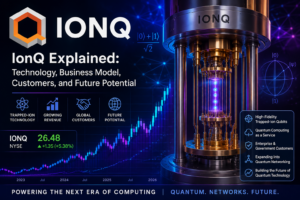
IonQ is one of the most closely watched pure-play quantum computing companies in the public market. Unlike diversified technology giants such as IBM, Microsoft, or Google, IonQ is built almost entirely around quantum computing, quantum networking, and the long-term commercialization of quantum systems.
For investors and technology followers, IonQ represents a high-risk, high-potential bet on the future of computing. The company is not simply selling software or cloud subscriptions; it is attempting to build a new computing architecture based on trapped-ion quantum technology.
That makes IonQ one of the most important companies to understand in the quantum computing sector.
What Does IonQ Do?
IonQ develops quantum computers using trapped-ion technology. Its systems are designed to solve complex computational problems that may eventually become difficult or impossible for classical computers to handle efficiently.
The company’s long-term target markets include:
- Drug discovery
- Materials science
- Financial modeling
- Logistics optimization
- Cybersecurity
- Artificial intelligence
- Quantum networking
- Government and defense applications
IonQ sells access to quantum computing systems, builds quantum hardware, develops quantum software capabilities, and is expanding into quantum networking.
In simple terms, IonQ is trying to become a full-stack quantum technology company.
IonQ’s Core Technology: Trapped-Ion Quantum Computing
IonQ’s main technological approach is called trapped-ion quantum computing.
In a trapped-ion system, individual charged atoms are isolated and controlled as qubits. These ions are manipulated using electromagnetic fields and lasers, allowing them to perform quantum operations.
This differs from superconducting quantum systems used by companies such as IBM and Google.
The trapped-ion approach is attractive because ions are naturally identical. In theory, this can help reduce certain hardware inconsistencies that occur in manufactured qubits.
IonQ argues that trapped-ion systems can offer strong qubit quality, high fidelity, and long-term scalability potential.
Why Fidelity Matters
In quantum computing, fidelity refers to the accuracy of quantum operations.
Higher fidelity means fewer errors.
This is extremely important because quantum systems are very sensitive. Even small errors can destroy a calculation. To build useful large-scale quantum computers, companies must reduce error rates and eventually use quantum error correction.
IonQ has emphasized high-fidelity quantum operations as a core part of its strategy. The company has reported achieving 99.99% two-qubit gate performance, which it presents as an important milestone for scaling toward fault-tolerant quantum computing.
IonQ’s Business Model
IonQ’s business model has several layers.
1. Quantum Computing Access
IonQ provides access to its quantum systems through cloud platforms and direct customer relationships. This allows researchers, enterprises, and institutions to test quantum algorithms without owning quantum hardware.
2. Quantum Systems and Hardware
IonQ is increasingly focused on selling or deploying quantum systems for commercial, government, and research customers.
This is important because system sales can generate larger contract values than simple cloud access.
3. Enterprise and Government Contracts
IonQ serves customers across commercial, international, and government markets. In Q1 2026, the company reported that roughly 60% of revenue came from commercial customers, 35% from international customers, and 35% from multi-product customers.
4. Quantum Networking
IonQ is also expanding beyond computing into quantum networking. Quantum networking could become important for secure communications, distributed quantum systems, and future quantum internet infrastructure.
5. Strategic Acquisitions
IonQ has used acquisitions to strengthen its technology stack. The company completed acquisitions of Oxford Ionics and Vector Atomic in 2025, which it said accelerated its full-stack quantum platform.
IonQ also announced a planned acquisition of SkyWater Technology for approximately $1.8 billion to bring more semiconductor manufacturing capability in-house and strengthen its hardware supply chain.
Revenue Growth and Financial Momentum
IonQ has shown strong revenue growth, although the business remains early-stage and highly investment-intensive.
The company reported $130 million in annual revenue for 2025, representing 202% year-over-year growth. More than 60% of that revenue came from commercial customers, while more than 30% came from international sales.
In Q1 2026, IonQ reported record GAAP revenue of $64.7 million, up 755% year over year, and raised full-year 2026 revenue guidance to between $260 million and $270 million.
These numbers suggest that IonQ is moving beyond purely experimental research and beginning to build commercial momentum.
However, investors should remember that quantum computing remains a young industry. Revenue growth can be uneven, and profitability may remain secondary while the company invests heavily in research, engineering, acquisitions, and scaling.
Who Are IonQ’s Customers?
IonQ’s customer base includes commercial enterprises, government organizations, research institutions, and international partners.
The company has highlighted commercial traction and global expansion as major parts of its growth strategy. In its Q1 2026 investor update, IonQ described solutions sold in more than 30 countries across five continents and referenced national quantum network activity in countries and regions including Poland, Romania, Slovakia, and Geneva.
The key point is that IonQ is not only selling to academic researchers. It is trying to build a commercial and international quantum platform.
Competitive Position
IonQ competes in a very difficult market.
Major competitors include:
- IBM
- Google Quantum AI
- Microsoft Azure Quantum
- Rigetti Computing
- D-Wave Quantum
- Quantinuum
- PsiQuantum
- neutral-atom quantum startups
IonQ’s main advantage is focus. It is a pure-play quantum company with strong investor recognition and a clear trapped-ion technology strategy.
But this also creates risk. Unlike IBM, Microsoft, or Google, IonQ does not have a massive legacy software, cloud, or advertising business supporting it. Its valuation and investor expectations are directly tied to quantum computing progress.
Advantages of IonQ
1. Pure-Play Quantum Exposure
IonQ gives investors direct exposure to quantum computing. If the sector grows rapidly, IonQ could benefit more directly than diversified technology companies.
2. Trapped-Ion Technology
IonQ’s trapped-ion approach is differentiated from superconducting competitors. If trapped-ion systems prove more scalable or accurate over time, IonQ could gain a major technical advantage.
3. Commercial Momentum
Revenue growth, international sales, and commercial customer contribution suggest that IonQ is building real market traction.
4. Strong Cash Position
IonQ reported significant cash, cash equivalents, and investments in recent results, giving the company more flexibility to fund research and acquisitions.
5. Expansion into Quantum Networking
Quantum networking may become an important long-term market. IonQ’s expansion into this area could create additional growth opportunities beyond computing.
Key Risks
1. Commercialization Timeline Risk
Quantum computing may take longer to commercialize than investors expect. If practical use cases develop slowly, revenue growth could disappoint.
2. Technology Risk
There is still no guaranteed winning quantum architecture. Trapped ions, superconducting qubits, photonics, neutral atoms, and other approaches may all compete for years.
3. Valuation Risk
Quantum stocks can trade on future expectations rather than current profits. If investor enthusiasm cools, share prices can be volatile.
4. Profitability Risk
IonQ is investing aggressively. Research and development, acquisitions, and scaling costs may keep profitability under pressure.
5. Competition from Big Tech
IBM, Google, Microsoft, Amazon, and Nvidia have enormous financial and technical resources. IonQ must keep innovating to remain relevant.
Future Goals and Roadmap
IonQ’s long-term goal is to build scalable, fault-tolerant quantum computing systems.
The company is focused on:
- Higher qubit performance
- Better gate fidelity
- Semiconductor-based manufacturing
- Quantum networking
- Larger quantum systems
- Enterprise and government adoption
- Global commercial expansion
Its planned SkyWater acquisition suggests IonQ wants more control over the hardware supply chain and semiconductor manufacturing process. This could become strategically important if quantum computers move from experimental systems to larger-scale production.
IonQ’s Role in the Future of AI
IonQ also positions quantum computing as a potential partner to artificial intelligence.
Quantum systems may eventually help with optimization, simulation, and machine learning workflows. IonQ has argued that quantum computers can work alongside GPU-based machine learning systems and may offer energy-efficiency benefits in some workloads.
This matters because AI infrastructure is becoming increasingly expensive and energy-intensive. If quantum systems can eventually solve specific AI-related problems more efficiently, IonQ could become relevant to the AI infrastructure ecosystem.
Investor Perspective
IonQ is not a traditional value stock.
It is a long-term technology growth story with significant uncertainty.
The bull case is that IonQ becomes one of the leading quantum computing platforms as the industry commercializes.
The bear case is that quantum adoption takes much longer than expected, competing technologies outperform trapped ions, or valuation expectations become too aggressive.
For investors, IonQ should be viewed as a speculative but important quantum computing company rather than a mature technology business.
Conclusion
IonQ is one of the most important pure-play quantum computing companies in the public market.
Its trapped-ion technology, commercial momentum, international expansion, and growing quantum platform make it a key company to watch in the race toward practical quantum computing.
However, the risks are equally significant. Quantum computing remains early, competition is intense, and commercialization timelines are uncertain.
IonQ’s future will depend on whether it can turn technical progress into scalable systems, real customer adoption, and sustainable revenue growth.
For QNTCORE readers, IonQ represents one of the clearest examples of how quantum computing is moving from scientific research toward commercial technology.
Disclaimer
This article is for informational and educational purposes only and should not be considered financial or investment advice. Investors should conduct their own research before making investment decisions.