For decades, classical computers have powered nearly every aspect of modern life. From smartphones and laptops to cloud computing platforms and artificial intelligence systems, traditional computing architecture remains the foundation of the digital world.
However, the emergence of quantum computing has sparked a fascinating question:
Will quantum computers eventually replace classical computers?
The idea sounds reasonable. Quantum computers can theoretically solve certain problems far faster than even the most powerful supercomputers. Governments, technology companies, and research institutions are investing billions of dollars into the development of practical quantum systems.
Yet the reality is more complex than many headlines suggest.
Rather than replacing classical computers entirely, quantum computing is more likely to complement existing systems and create a new era of hybrid computing.
Understanding Classical Computing
Classical computers process information using bits.
A bit can exist in one of two states:
- 0
- 1
Every application, website, video game, financial transaction, and artificial intelligence system ultimately relies on billions of these binary operations.
Modern processors have become incredibly powerful through decades of innovation. Today’s computers can perform trillions of calculations every second while consuming relatively little energy compared with earlier generations.
Classical computing remains extremely efficient for most everyday tasks.
Activities such as:
- Web browsing
- Video streaming
- Office productivity
- Software development
- Gaming
- Database management
are already handled exceptionally well by traditional systems.
This is one reason why classical computers are unlikely to disappear anytime soon.
What Makes Quantum Computing Different?
Quantum computers operate using quantum bits, commonly known as qubits.
Unlike classical bits, qubits can exist in multiple states simultaneously through a phenomenon known as superposition.
Quantum systems also utilize another phenomenon called entanglement, allowing qubits to become correlated in ways that have no classical equivalent.
These unique properties enable quantum computers to explore many possible solutions simultaneously for certain types of problems.
As a result, quantum computing has the potential to outperform classical computers in highly specialized areas.
Problems Quantum Computers May Solve Better
Quantum computing is not designed to accelerate every task.
Instead, it offers advantages for specific categories of computational challenges.
Potential applications include:
Drug Discovery
Scientists can use quantum simulations to model molecular interactions with unprecedented precision.
This could accelerate the development of new medicines and treatments.
Materials Science
Researchers may discover new materials for batteries, semiconductors, and energy storage systems by simulating atomic behavior.
Optimization
Quantum algorithms could help improve:
- Supply chains
- Transportation networks
- Manufacturing processes
- Financial portfolio optimization
Cryptography
Quantum computers may eventually break certain encryption methods that protect digital communications today.
This is one reason governments and cybersecurity organizations are developing post-quantum cryptography standards.
Artificial Intelligence
Although still experimental, quantum computing may one day enhance certain machine learning techniques and optimization processes.
Why Quantum Computers Will Not Replace Your Laptop
One of the biggest misconceptions surrounding quantum computing is the belief that quantum machines will eventually replace personal computers.
In reality, quantum computers are extremely specialized.
They require:
- Cryogenic cooling systems
- Sophisticated error correction
- Highly controlled environments
- Specialized quantum hardware
Most current quantum systems operate at temperatures colder than outer space.
Because of these requirements, quantum computers are unlikely to become consumer devices in the foreseeable future.
Nobody will be browsing social media, writing emails, or playing video games directly on a quantum computer.
Classical systems remain far more practical for everyday computing needs.
The Hybrid Future
Many experts believe the future of computing will be hybrid rather than purely quantum.
In a hybrid model:
- Classical computers handle routine workloads.
- Quantum processors solve highly specialized problems.
- Results are returned to classical systems for further processing.
This approach combines the strengths of both technologies.
Major technology companies are already developing software frameworks designed specifically for hybrid quantum-classical workflows.
What Companies Are Leading the Quantum Race?
Several organizations are competing to advance quantum technology.
IBM
IBM has invested heavily in quantum research and has developed one of the largest quantum ecosystems in the world.
The company continues to publish ambitious roadmaps focused on scaling quantum systems and improving error correction.
IonQ
IonQ focuses on trapped-ion quantum technology and is one of the most recognized publicly traded pure-play quantum computing companies.
Google achieved global attention after demonstrating quantum supremacy in a research experiment, highlighting the potential capabilities of future quantum systems.
Microsoft
Microsoft continues investing in quantum hardware, software, and cloud-based quantum services through Azure.
Rigetti and D-Wave
These companies are pursuing alternative approaches to quantum computing and continue developing specialized systems for commercial applications.
The Biggest Challenges Facing Quantum Computing
Despite significant progress, major obstacles remain.
Error Rates
Quantum systems are highly sensitive to environmental interference.
Even tiny disturbances can introduce computational errors.
Scalability
Building large-scale quantum computers with millions of reliable qubits remains a significant engineering challenge.
Cost
Developing and operating quantum hardware requires substantial investment.
Commercial Adoption
Many practical applications are still being explored, and widespread adoption may take years or even decades.
Could Quantum Computers Replace Supercomputers?
In certain specialized scenarios, quantum systems may eventually outperform traditional supercomputers.
However, this does not necessarily mean replacement.
Much like GPUs did not eliminate CPUs, quantum processors may become another layer of computing infrastructure rather than a complete substitute.
Supercomputers, cloud platforms, GPUs, CPUs, and quantum processors may all coexist within future computing ecosystems.
The Long-Term Outlook
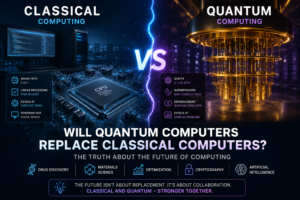
The future of computing will likely involve cooperation rather than competition between classical and quantum systems.
Classical computers will continue powering everyday applications, business operations, and cloud infrastructure.
Quantum computers will address specialized challenges that are currently impossible or impractical for classical machines.
This partnership could unlock breakthroughs in science, medicine, finance, artificial intelligence, and national security.
Conclusion
Quantum computers are unlikely to replace classical computers in the way many people imagine.
Instead, they are expected to become powerful tools designed for solving highly specialized problems beyond the capabilities of traditional systems.
The future is not classical versus quantum.
The future is classical and quantum working together.
As quantum technology continues to mature, hybrid computing may become one of the most important technological developments of the 21st century.
Disclaimer
This article is for educational and informational purposes only. Technological developments discussed in this article are based on current research and industry expectations and should not be interpreted as guarantees of future outcomes.