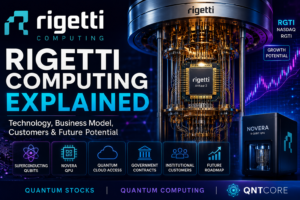
Rigetti Computing is one of the most important pure-play quantum computing companies in the public market. While IonQ focuses on trapped-ion quantum computing, Rigetti is built around superconducting quantum processors, the same broad technology category pursued by companies such as IBM and Google.
This makes Rigetti an important company to understand for anyone following the quantum computing industry.
Rigetti is not simply a software company. It develops quantum processing units, quantum systems, control electronics, cloud access, and hybrid quantum-classical computing infrastructure. Its strategy is centered on building scalable superconducting quantum computers that can eventually support real-world enterprise, government, and research applications.
For investors and technology followers, Rigetti represents a speculative but strategically important quantum computing company.
What Does Rigetti Computing Do?
Rigetti develops superconducting quantum computers and related quantum computing systems.
The company works across several areas:
- Quantum processing units
- On-premises quantum computers
- Quantum cloud access
- Quantum-classical hybrid systems
- Quantum software tools
- Government and research contracts
- Quantum hardware components
Rigetti describes itself as a full-stack quantum computing company. This means it is not only designing chips, but also building the systems, control architecture, and software layer required to operate quantum computers.
Its long-term goal is to make quantum computing useful for practical workloads in areas such as optimization, simulation, machine learning, materials science, and government research.
Rigetti’s Core Technology: Superconducting Quantum Computing
Rigetti uses superconducting qubit technology.
Superconducting qubits are artificial quantum systems built using electrical circuits that operate at extremely low temperatures. These systems require dilution refrigerators that cool the quantum processor close to absolute zero.
This is the same broad technology family used by IBM and Google Quantum AI.
The advantage of superconducting quantum computing is that it is relatively compatible with semiconductor-style fabrication methods. Since the chips are manufactured using advanced engineering processes, the technology may have a clearer path toward scaling if fabrication, control, and error correction improve.
However, superconducting qubits also face major challenges. They are sensitive to noise, require complex cryogenic environments, and must achieve very high fidelity to become useful at large scale.
Why Rigetti’s Technology Matters
Rigetti’s technical strategy is important because superconducting quantum computing is one of the most heavily researched quantum architectures in the world.
Compared with trapped-ion systems, superconducting systems can often perform very fast gate operations. Speed is one of the reasons superconducting platforms remain attractive for quantum computing research.
Rigetti has worked on improving gate fidelity, chip architecture, and modular scaling. The company has discussed high-fidelity development and chiplet-based designs as part of its approach to building larger systems.
In 2025, Rigetti reported progress in two-qubit gate fidelity, including a reported 99.9% two-qubit gate fidelity at 28 nanoseconds on a prototype platform, according to industry coverage of its results. This type of technical progress matters because error rates are one of the biggest barriers to practical quantum computing.
Novera QPU: Rigetti’s Smaller On-Premises Quantum Product
One of Rigetti’s notable products is the Novera QPU.
Novera is a 9-qubit quantum processing unit designed for researchers, national labs, universities, and quantum computing centers that want direct access to quantum hardware.
Rigetti describes Novera as a 9-qubit version of its more powerful quantum computer architecture, designed to give customers access to superconducting quantum technology. The company states that the Novera QPU is ready to ship and allows organizations to explore quantum hardware directly.
Novera is important because it gives Rigetti a product that can be sold into research and institutional markets today, even before large-scale fault-tolerant quantum computers exist.
This creates a more immediate commercial path than relying only on future cloud usage.
Ankaa Architecture and Scaling Strategy
Rigetti’s Novera QPU is based on its Ankaa-class architecture. The Novera product documentation describes it as a small-scale version of Rigetti’s deployed 84-qubit Ankaa system and explains that the system includes quantum hardware below the mixing chamber plate of a dilution refrigerator.
Rigetti has also emphasized tunable couplers and square-lattice architecture. These design choices are intended to support denser connectivity and fast two-qubit operations.
For quantum computing, architecture matters because scaling is not simply about adding more qubits. The qubits must also interact reliably, operate with low error rates, and be controlled effectively.
Rigetti’s long-term challenge is to move from small and medium-scale quantum processors toward larger systems that can perform valuable computations.
Business Model
Rigetti’s business model has several components.
1. On-Premises Quantum Systems
Rigetti sells quantum processing units and quantum systems to research institutions, national labs, and government-linked organizations.
This is one of the company’s most important near-term business opportunities.
In 2026, Rigetti announced an approximately $8.4 million purchase order from India’s Centre for Development of Advanced Computing for a 108-qubit on-premises superconducting quantum computer. The system is expected to be deployed in the second half of 2026 and integrated into C-DAC’s high-performance computing environment.
This is significant because on-premises system sales can generate larger contract values than basic cloud access.
2. Quantum Processing Unit Sales
Rigetti’s Novera QPU gives the company a hardware product that can be sold to organizations building quantum computing research infrastructure.
Customers may use these systems for hardware research, algorithm development, quantum control experimentation, and hybrid computing work.
3. Cloud-Based Quantum Access
Rigetti also supports access to quantum systems through cloud and platform integrations. Cloud access allows users to experiment with quantum computing without purchasing hardware directly.
This business model is similar to how other quantum companies provide access through cloud platforms.
4. Government and Research Contracts
Government and national research programs are a major part of the quantum computing market.
Quantum technology is strategically important for national security, advanced computing, cryptography, and scientific leadership. As a result, government-backed programs may remain important customers for companies like Rigetti.
Rigetti’s investor relations page has also highlighted recent government-related activity, including a letter of intent with the U.S. Government for quantum computing research.
5. Partnerships and Ecosystem Development
Rigetti has worked with partners to build an ecosystem around its Novera QPU and quantum systems. The company’s Novera partner program is designed to help customers assemble quantum systems using hardware, software, and service partners.
This ecosystem approach may help Rigetti reach more customers without building every component alone.
Customers and Market Traction
Rigetti’s customers are mostly institutional rather than consumer-facing.
Potential and reported customer groups include:
- National laboratories
- Government agencies
- Universities
- Quantum research centers
- High-performance computing centers
- Defense-related organizations
- Enterprise research teams
The Novera QPU has been sold to leading national labs including the Superconducting Quantum Materials and Systems Center led by Fermilab and the Air Force Research Lab, as well as Horizon Quantum Computing in Singapore, according to a Rigetti and Quantum Machines announcement.
The company’s $8.4 million C-DAC order is also notable because it shows demand for on-premises quantum systems from international government-backed computing institutions.
This suggests that Rigetti’s near-term market is not mass commercial adoption, but specialized institutional adoption.
Financial Position and Revenue
Rigetti remains an early-stage company with relatively small revenue compared with large technology firms.
For full-year 2025, Rigetti reported total revenue of $7.1 million, according to multiple financial result summaries.
The company also reported meaningful operating losses, reflecting the heavy cost of quantum hardware research, engineering, and commercialization. This is normal for early-stage deep technology companies, but it is a major risk for investors.
Rigetti’s Q1 2026 revenue was reported at approximately $4.4 million, up significantly year over year, driven partly by quantum computer and component sales.
The key point is that Rigetti is still small financially, but its revenue mix may improve if on-premises system sales grow.
Competitive Position
Rigetti competes in one of the hardest areas of technology.
Its competitors include:
- IBM
- Google Quantum AI
- Microsoft Azure Quantum
- IonQ
- D-Wave
- Quantinuum
- PsiQuantum
- other superconducting, photonic, neutral-atom, and trapped-ion companies
Rigetti’s direct architectural competition is strongest against companies pursuing superconducting quantum computing, especially IBM and Google.
However, Rigetti’s position is different. IBM and Google are massive technology companies with quantum divisions. Rigetti is a pure-play quantum company focused more narrowly on superconducting quantum hardware and systems.
This gives Rigetti focus, but also increases risk.
Advantages of Rigetti
1. Superconducting Technology Platform
Superconducting quantum computing is one of the leading quantum architectures. If this architecture wins or remains one of the dominant approaches, Rigetti could benefit.
2. Full-Stack Strategy
Rigetti works across hardware, systems, software, and control infrastructure. This gives the company more control over the quantum computing stack.
3. On-Premises Product Strategy
Products like Novera and larger on-premises systems allow Rigetti to sell hardware into research and government markets today.
This is important because pure cloud-based quantum revenue may take longer to scale.
4. Institutional Customer Base
National labs, research centers, and government institutions are among the most serious early adopters of quantum computing.
Rigetti’s traction in these areas gives it credibility.
5. Chiplet-Based Scaling Potential
Rigetti’s approach includes chiplet-based scaling concepts. If successful, this could help the company move toward larger quantum systems over time.
Key Risks
1. Small Revenue Base
Rigetti’s revenue remains very small compared with its public market valuation and long-term expectations.
This makes the stock highly sensitive to investor sentiment.
2. High Operating Losses
Quantum hardware development is expensive. Rigetti must continue investing heavily before the market becomes mature.
3. Competition from IBM and Google
IBM and Google have far greater financial resources, research teams, and cloud ecosystems.
Rigetti must prove that its smaller, more focused approach can compete.
4. Technology Risk
Superconducting quantum computing is promising, but not guaranteed to dominate. Other architectures, including trapped-ion, photonic, and neutral-atom systems, may outperform it in certain use cases.
5. Commercialization Timeline Risk
The biggest risk for all quantum companies is timing.
Useful commercial quantum advantage may take longer than expected. If customers delay adoption, revenue growth may remain uneven.
6. Contract Lumpiness
Quantum system sales can be irregular. A single large order can significantly affect quarterly revenue, while delays can make results look weak.
This means Rigetti’s financial results may be volatile from quarter to quarter.
Future Goals
Rigetti’s future goals appear focused on:
- Scaling superconducting quantum processors
- Improving gate fidelity
- Expanding on-premises quantum system sales
- Building larger systems such as 36-qubit, 84-qubit, and 108-qubit platforms
- Supporting hybrid quantum-classical workloads
- Serving government, research, and institutional customers
- Developing a broader quantum ecosystem around its hardware
The 108-qubit C-DAC order is particularly important because it shows the type of larger system deployment Rigetti wants to support.
Rigetti vs IonQ
Rigetti and IonQ represent two very different quantum strategies.
IonQ uses trapped-ion technology. Rigetti uses superconducting qubits.
IonQ emphasizes high-fidelity trapped-ion systems and broader quantum networking ambitions. Rigetti emphasizes superconducting QPUs, on-premises systems, and full-stack quantum-classical computing.
For investors, IonQ may appear more visible and commercially recognized. Rigetti may appeal to those who believe superconducting quantum computing will remain a major architecture and that on-premises institutional systems will become an important market.
Neither approach has fully won yet.
Investor Perspective
Rigetti should be viewed as a speculative quantum computing stock.
It has real technology, real products, and real institutional customers. However, it also has small revenue, high losses, intense competition, and uncertain commercialization timelines.
The bull case is that Rigetti becomes one of the key superconducting quantum hardware providers as demand for on-premises quantum systems grows.
The bear case is that larger competitors dominate the market, quantum adoption takes longer than expected, or Rigetti struggles to scale revenue fast enough.
For QNTCORE readers, Rigetti is an important company to watch, but it should be analyzed carefully and objectively.
Conclusion
Rigetti Computing is one of the most important pure-play superconducting quantum computing companies in the public market.
Its technology, Novera QPU product, on-premises system strategy, and institutional customer base make it a serious participant in the quantum computing race.
However, the company remains early-stage. Revenue is still small, losses are significant, and competition is intense.
Rigetti’s future depends on whether it can scale superconducting quantum systems, improve fidelity, win more institutional customers, and turn technical progress into sustainable commercial revenue.
For investors and technology observers, Rigetti is not just another speculative stock. It is a window into the future of superconducting quantum computing.
Disclaimer
This article is for informational and educational purposes only and should not be considered financial or investment advice. Investors should conduct their own research before making investment decisions.