Quantum computing is moving from laboratory research into one of the most competitive technology races in the world. Two names often appear near the center of that race: IBM and IonQ.
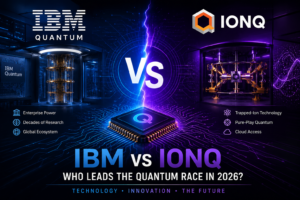
IBM represents the established technology giant with decades of research experience, deep enterprise relationships, and a broad quantum roadmap. IonQ represents the ambitious pure-play quantum company focused on trapped-ion technology, cloud access, and long-term commercial adoption.
Both companies are pursuing the same broad goal: building quantum systems powerful enough to solve problems beyond the reach of classical computers. However, their strategies, technologies, business models, and investor profiles are very different.
Why This Comparison Matters
Quantum computing is still an early-stage industry. Most companies in the sector are not yet generating revenue at a scale that matches the long-term excitement around the technology.
That makes company selection especially important.
Investors and technology observers need to understand the difference between:
- A diversified technology company investing in quantum
- A pure-play quantum company built entirely around the sector
IBM and IonQ represent these two very different approaches.
IBM Quantum: The Enterprise Giant
IBM has been one of the most important names in quantum computing for years. The company has built a large quantum ecosystem that includes hardware, software tools, cloud access, research partnerships, and enterprise experimentation.
IBM’s advantage is scale.
The company already works with major corporations, governments, universities, and research institutions. Its quantum strategy fits into a broader enterprise technology business that includes hybrid cloud, artificial intelligence, consulting, and infrastructure software.
IBM has publicly outlined a long-term quantum roadmap focused on scaling systems, improving error correction, and moving toward fault-tolerant quantum computing. IBM says it is working toward near-term quantum advantage by the end of 2026 and large-scale fault-tolerant quantum computing later in the decade.
IonQ: The Pure-Play Quantum Challenger
IonQ is one of the most visible publicly traded pure-play quantum computing companies. Unlike IBM, IonQ is not a diversified enterprise technology company. Its identity is centered directly on quantum computing.
The company uses trapped-ion technology, which relies on individual charged atoms as qubits. IonQ presents this architecture as highly accurate and scalable for future quantum systems. The company also offers cloud access and enterprise solutions for real-world quantum applications.
IonQ’s appeal is simple: if quantum computing becomes a major commercial industry, a pure-play company could benefit more directly than a diversified giant.
But that opportunity comes with greater risk.
Technology Approach
IBM and IonQ use different quantum architectures.
IBM has historically focused on superconducting quantum processors. This approach is widely researched and has attracted significant investment across the industry. IBM’s roadmap emphasizes scaling processor performance, improving quantum-classical workflows, and developing fault-tolerant systems.
IonQ focuses on trapped-ion systems. Trapped ions are often discussed for their potential advantages in qubit quality, connectivity, and precision. IonQ’s technology positioning centers on building systems that can eventually address problems in logistics, drug discovery, finance, and national security.
There is no final winner yet. Quantum computing may remain a multi-architecture industry for years, with superconducting, trapped-ion, photonic, and neutral-atom systems serving different use cases.
Business Model Difference
IBM’s quantum business is part of a much larger technology company.
That gives IBM several advantages:
- Stable revenue from existing businesses
- Deep enterprise relationships
- Long-term research funding capacity
- Integration with cloud and AI infrastructure
However, it also means quantum computing may not move IBM’s stock as dramatically as it could move a smaller pure-play company.
IonQ is different.
IonQ’s valuation is much more directly tied to the future of quantum computing. If the industry accelerates, IonQ could attract significant investor attention. If commercialization takes longer than expected, the company may face pressure because its revenue base remains much smaller.
Strengths of IBM
IBM’s biggest strength is credibility.
The company has:
- A long history in computing research
- A large quantum developer ecosystem
- Enterprise customer access
- Financial resources to support long-term development
- A structured roadmap toward fault-tolerant quantum computing
IBM does not need quantum computing to generate immediate large-scale revenue for the company to survive. That makes it a more stable way to gain exposure to the quantum theme.
Risks for IBM
IBM’s main risk is that quantum computing may not become a major enough business to materially change the company’s overall growth profile.
Because IBM is diversified, quantum success could be meaningful technologically but less explosive financially.
Investors looking for high-growth quantum exposure may find IBM too conservative compared with smaller companies.
Strengths of IonQ
IonQ’s biggest strength is focus.
The company is directly tied to the quantum computing opportunity. It does not have to balance quantum against many unrelated legacy businesses.
IonQ also benefits from strong brand recognition among public-market investors interested in quantum technology. Its trapped-ion approach gives it a differentiated position in the sector.
For investors seeking direct quantum exposure, IonQ is one of the most obvious names to watch.
Risks for IonQ
IonQ also carries significant risk.
The company operates in a highly experimental industry where commercialization timelines are uncertain. Revenue remains relatively small compared with established technology companies, and research and development costs can remain high for years.
IonQ’s stock may also be highly sensitive to market sentiment. When investors become excited about quantum computing, shares may rise sharply. When expectations cool, volatility can be severe.
Which Company Is Ahead?
The answer depends on how “ahead” is defined.
From an enterprise ecosystem and research scale perspective, IBM has a strong advantage. It has more resources, more established customer relationships, and a long-standing presence in quantum computing.
From a pure-play investment exposure perspective, IonQ may be more attractive to investors who want direct participation in the quantum theme.
IBM is the safer and more diversified quantum bet.
IonQ is the higher-risk, higher-upside quantum bet.
Investor Perspective
For conservative investors, IBM may offer quantum exposure without relying entirely on the success of one emerging technology.
For aggressive investors, IonQ may offer more direct exposure to the growth of quantum computing, but with greater volatility and execution risk.
A balanced approach may involve watching both companies:
- IBM for roadmap execution and enterprise adoption
- IonQ for technological milestones and commercial progress
Conclusion
IBM and IonQ represent two very different paths in the quantum computing race.
IBM brings scale, enterprise credibility, and long-term research depth. IonQ brings focus, trapped-ion specialization, and direct exposure to the quantum computing opportunity.
There may not be a single winner in the near term. The quantum industry is still young, and multiple architectures may coexist for years.
For now, IBM appears better positioned as a stable enterprise leader, while IonQ remains one of the most compelling pure-play quantum growth stories in public markets.
Disclaimer
This article is for informational and educational purposes only and should not be considered financial or investment advice. Investors should conduct their own research before making investment decisions.