Quantum computing has evolved from a purely academic concept into one of the most closely watched technologies in the world. Governments, research institutions, and technology companies are investing billions of dollars to develop practical quantum systems capable of solving problems beyond the reach of classical computers.
While the industry remains in its early stages, public market investors have already gained access to several companies leading the race toward commercial quantum computing.
As interest in artificial intelligence, advanced computing, and next-generation technologies continues to grow, quantum computing stocks have become an increasingly important sector to watch.
Why Investors Are Paying Attention
Quantum computing promises to address complex challenges in areas such as:
-
Drug discovery
-
Materials science
-
Financial modeling
-
Cybersecurity
-
Logistics optimization
-
Artificial intelligence
The potential economic impact of these applications could be enormous. According to industry forecasts, the global quantum computing market may expand significantly over the coming decades as hardware improves and commercial adoption accelerates.
Although the sector remains speculative, investors are increasingly positioning themselves for long-term growth.
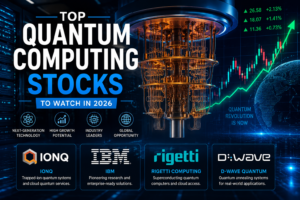
IonQ (NYSE: IONQ)
IonQ is widely regarded as one of the most recognizable pure-play quantum computing companies in public markets.
The company focuses on trapped-ion technology, a quantum architecture known for high-fidelity operations and scalability potential. IonQ has established partnerships with major cloud providers, enabling developers and researchers to access quantum systems through cloud platforms.
Many investors view IonQ as one of the leading candidates to benefit from the commercialization of quantum computing.
Strengths
-
Strong brand recognition
-
Cloud accessibility
-
Growing enterprise relationships
-
Focus on scalable trapped-ion systems
Risks
-
Limited current revenue
-
High research and development costs
-
Long commercialization timeline
IBM (NYSE: IBM)
IBM has been involved in quantum computing research for decades and remains one of the industry’s most influential participants.
Unlike smaller pure-play companies, IBM generates substantial revenue from software, consulting, and enterprise services. This diversified business model provides financial stability while the company continues investing in quantum technology.
IBM’s quantum roadmap and ecosystem remain among the most advanced in the industry.
Strengths
-
Extensive research resources
-
Large enterprise customer base
-
Strong balance sheet
-
Established quantum ecosystem
Risks
-
Quantum represents only one part of IBM’s business
-
Slower growth profile compared with smaller competitors
Rigetti Computing (NASDAQ: RGTI)
Rigetti is another publicly traded company focused exclusively on quantum computing.
The company develops superconducting quantum processors and provides cloud-based quantum computing services. Investors interested in high-risk, high-reward opportunities often view Rigetti as a speculative bet on future quantum adoption.
Strengths
-
Pure quantum exposure
-
Proprietary hardware development
-
Cloud-based access model
Risks
-
Early-stage commercialization
-
Competitive market environment
-
Financial volatility
D-Wave Quantum (NYSE: QBTS)
D-Wave follows a different approach from many competitors by focusing on quantum annealing technology.
While not designed for every quantum application, quantum annealing can address certain optimization problems that are relevant to real-world business use cases.
D-Wave has spent years building commercial relationships and practical applications for its technology.
Strengths
-
Real-world optimization focus
-
Commercial customer experience
-
Specialized market positioning
Risks
-
Technology differs from gate-based quantum systems
-
Long-term competitive uncertainty
The Long-Term Opportunity
Investing in quantum computing today is similar to investing in early internet companies decades ago. The technology has tremendous potential, but commercialization remains uncertain.
Some companies may become major industry leaders, while others could struggle to achieve profitability. Investors should therefore view quantum computing as a long-term theme rather than a short-term opportunity.
Diversification and patience remain essential.
Conclusion
Quantum computing continues to move closer to practical applications, attracting growing interest from investors worldwide. Companies such as IonQ, IBM, Rigetti, and D-Wave represent different approaches to a technology that could transform entire industries.
While risks remain significant, the sector offers exposure to one of the most ambitious technological developments of the 21st century. For investors willing to accept uncertainty, quantum computing stocks may be worth watching closely in 2026 and beyond.